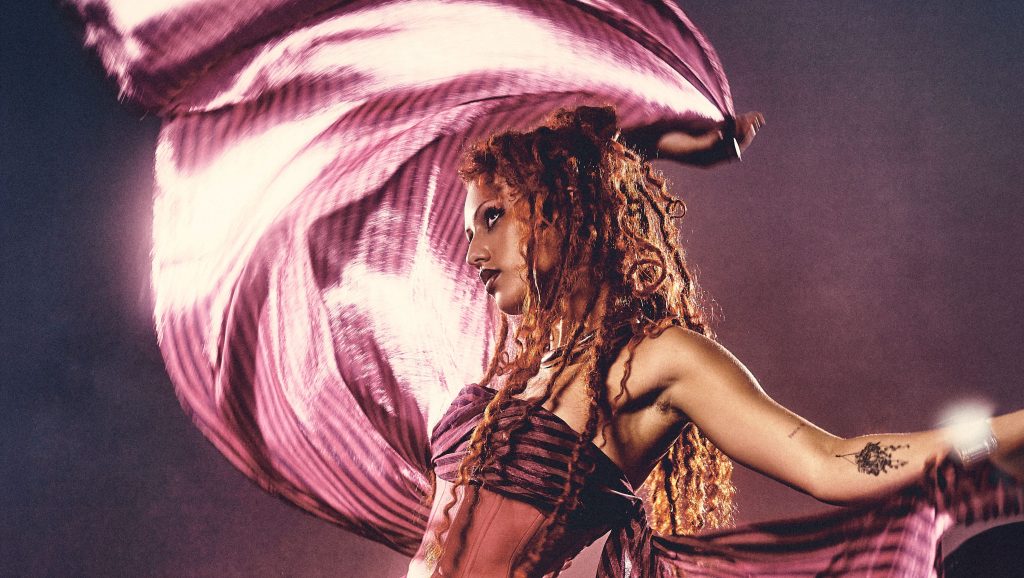
Meet Naomi Schiff – the Rwandan-Belgian ex-racer turned TV presenter who has been into racing and karting ever since she was young and ultimately qualified to be part of the South African national team when she was only a teenager! Her racing career was successful, to say the least – she has more than excelled in prestigious races like the Clio Cup China Series and was also elected to participate in the inaugural W Series. Undoubtedly, she is a role model for female racers worldwide.
Ultimately, Schiff took the leap to go more behind the scenes. Now, she is Sky Sports’ lead F1 analyst, and teaming up with Tinie Tempah, she hosts Channel 4’s Bangers: Cars of The People. Her success on and off the track solidifies her as a key figure shaping the future of motorsports with her inclusive approach.
In an exclusive interview with Principle, she tells us all about her decision to work in TV, ideas for the future, and fun anecdotes about James Bond.
PHOTOGRAPHY
Max Giorgeschi at W Mgmt
FASHION
Jamie McFarland
HAIR
Lucia Josephine using Curlsmith,
Mielle Organics, and GHD
MAKE-UP
Buster Knight at The Only Agency
using Makeup By Mario
FASHION ASSISTANT
Catherine Moran
You’re a former racing driver, turned TV presenter. But before we get into the TV presenting part of your life, I just wanted to ask for those who aren’t aware yet from our readers, what was the moment you knew that all things racing was your true passion – was there a key moment in your childhood where you were like, “Yeah, that’s what I want to do?“
That’s a really good question. I started racing when I was 11 so some of the memories are a little bit distant. My career kind of progressed quite quickly at that age. I didn’t start racing at 11, but I was exposed to karting at the age of 11 and eventually got a go-kart. And then I started racing within a year. It was the year that I was turning 12 that I started racing. Within a year from the time I started racing, I finished second in the national championships. So I finished second in the South African championship and that qualified me to be a part of the South African national team in the world championships. I represented South Africa for four years consecutively in the world championships. And I think the first year I got there, that was really an eye-opening moment for me. I mean, I already was so in love with racing before I kind of hit the world map. I think it was once I crossed the pond – you know, karting in South Africa is one thing, but karting in Europe is really where you want to be. So when I got there and realized that I was a part of it, and with the platform that they have in Europe, I just knew, that’s the dream that I was going to chase.
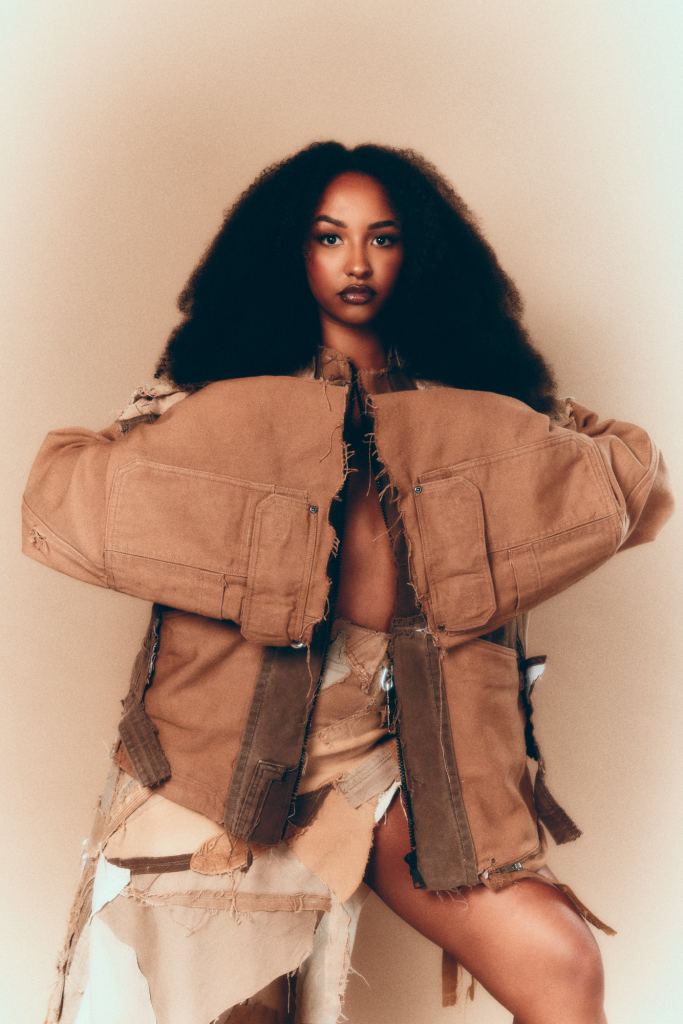

Full look Natasha Zinko / Boots Underground
That is so impressive! What were the first races that you watched on TV and who were the race drivers that really paved the way for you?
So this is a less distant memory because this is obviously quite a clear moment and quite a defining moment for me. So I was already watching Formula 1 before I participated in racing at all because my dad was a big fan of the sport. My dad, to be fair, was also a racing driver in his time as well, but I’d never known my dad as a racing driver, so he stopped racing long before I was born. But I would sit on the couch with my dad and watch it. I wasn’t that interested in racing before I started doing it myself, because it’s a sport that kids aren’t exposed to at school, so you don’t really get it, you know? You just kind of feel like people are driving around in circles and whatever. So Formula 1 is a little bit more complex in that there’s strategies, there’s pit stops, there’s a whole lot of things going on and then people are out of sequence. So it’s not always the easiest sport to understand, especially at that age when you don’t really know anything about it. So I didn’t take an interest in it immediately, but once I started racing or driving, I started paying a lot more attention in the year that I started racing, which was 2007. That was also the same year that Lewis [Hamilton] entered Formula 1, and my dad had already been saying, “Look out for this kid.” Like, “He’s coming up from Formula 3.” He’s going to be the one-to-watch type of thing. For me, the thing that really stuck is that when I went to the track, there wasn’t anybody who looked like me. And that’s quite obvious. I think there’s already a real lack of women. But then to have a woman who is Black in motorsports is unheard of. So there was no one really on this track that I identified with. And I guess to me, Lewis was the closest thing to an identifiable role model that I could have had. It wasn’t exactly like me, but it was something like me. He was definitely the person who paved the way for me, someone who I looked up to throughout my career when I was racing. It was kind of like a psychological thing that if he did well, I would do well.
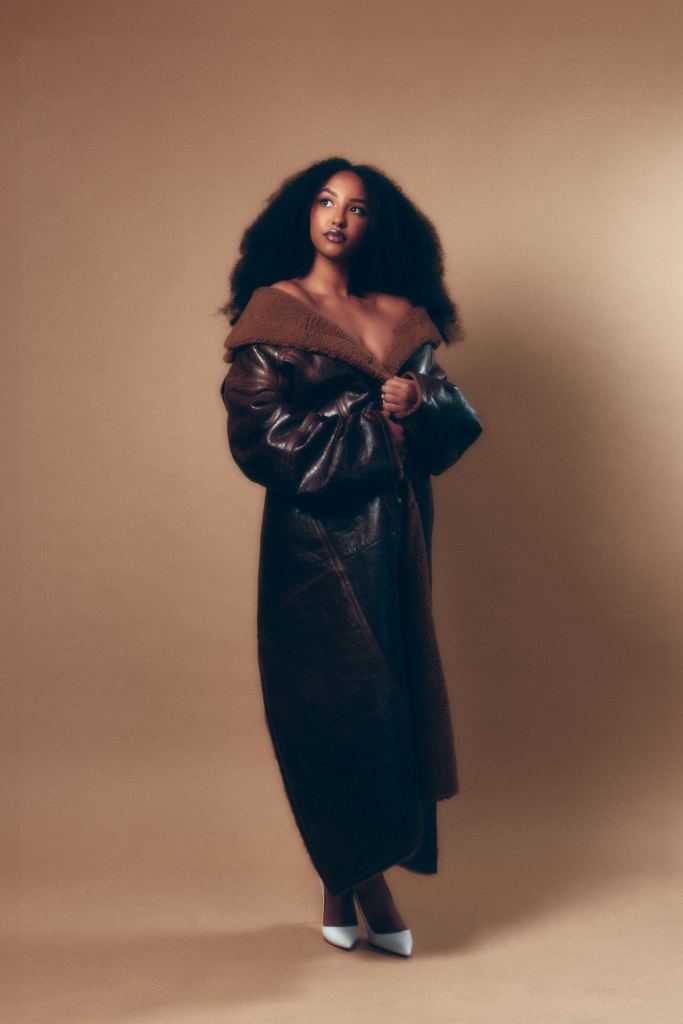
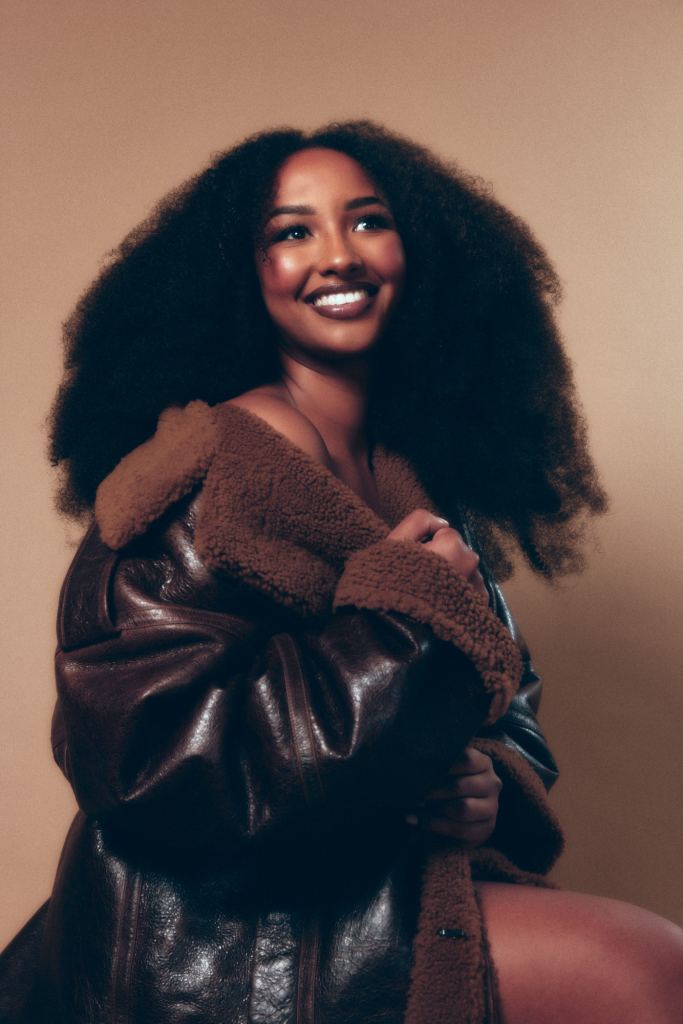
Coat Remain / Shoes Manolo Blahnik
I love that, and he is still killing it many years later – and so are you! Now that you work as a TV presenter, did you find it was quite an adjustment to go from being an active racing driver to then being on TV? What did you find the most challenging about that, and equally the most rewarding?
The first thing I got rid of was my gym routine, which I probably shouldn’t have, [laughs]. Life gets busy sometimes. There was less of a need for that. There was less pressure to be in the gym every day. It was borderline a perk to the job, but no, more seriously, it was definitely a big change. And to be quite honest, I think I was very lucky that it came at the time that it did because I wasn’t ready to hang up my helmet. It wasn’t a decision that I’d seen coming or that I was preparing myself for. I always used to say to people if I wasn’t a racing driver, then who would I be? It was such a big part of my identity. Like, whenever I would be introduced to people, it would be like, “Oh, this is Naomi, she races,” or “Naomi the racing driver.” And then it takes up the conversation in the room, and everybody’s so interested. And I just didn’t know who I would be without all of that. And I think a lot of athletes, when they retire, have this identity crisis to some extent. So to be honest, I feel very grateful that it came when it did because it not only kept me in the sport that I love, which is 100 percent the biggest perk that I get to stay in the sport that I’m passionate about and I get to still earn a living out of it but also being at the absolute pinnacle of the sport in Formula 1. It feels like a full circle moment to be where I am because you could see my career as somewhat of a failure to some people, it might seem that way because a lot of people invested a lot of money into racing for me, and whether that’s sponsors or family and the sacrifices that everyone had to make. I carried a lot of that weight on my shoulders. So to still be involved in the sport and in a way that’s respected by my peers is very full circle to me.
People always used to ask me, “What advice would you give to your younger self?” or “What advice would you give to young people?” There’s always a question like that and my answer has somewhat changed but in the past. I would always say, “Don’t stand in the way of your dreams.” And because there will be enough barriers along the way, if you make yourself a barrier, it makes it just that much harder to get there. So believe in yourself, back yourself, and don’t give up. Now I still say that, but I feel like the giving up part is slightly harsh because there is a point in time where I had to give up and that’s okay, you know? The advice sort of changes in the sense that I kind of add to that, do your best, try hard, don’t give up. But if you feel that a situation is not serving you, then don’t be afraid to adjust because plan B isn’t necessarily a failure, you know?
I totally agree – that is such a brilliant outlook on life as you never know what’s coming tomorrow.
I never allowed there to be another plan, I had to get to Formula 1 at all costs. I feel like I should maybe have let go a little earlier because I wasn’t enjoying racing when I retired. I wasn’t enjoying it anymore. I wasn’t racing at the level I wanted to. I didn’t have the financial backing that I required to perform at the level I wanted to. I don’t want to say flogging a dead horse, but it was really like really just picking at straws in the end. I should have opened my eyes to other things sooner but to be honest, things just fell into place the way they did and I’m so so grateful that they did. I had a lot of people counting on me and maybe they weren’t even counting on me as much as I thought. Maybe I was putting some of that pressure on myself, but it wasn’t just about letting myself down. There were so many other people I didn’t want to let down as well. To answer your question, it keeps me in the sport that I love. I always used to say I was so lucky to be paid to do something I love. I can’t say that I don’t love my job. I feel like it’s an absolute dream job to have and to stay again in the sport that I love. My identity crisis gave me a soft pillow to land on.
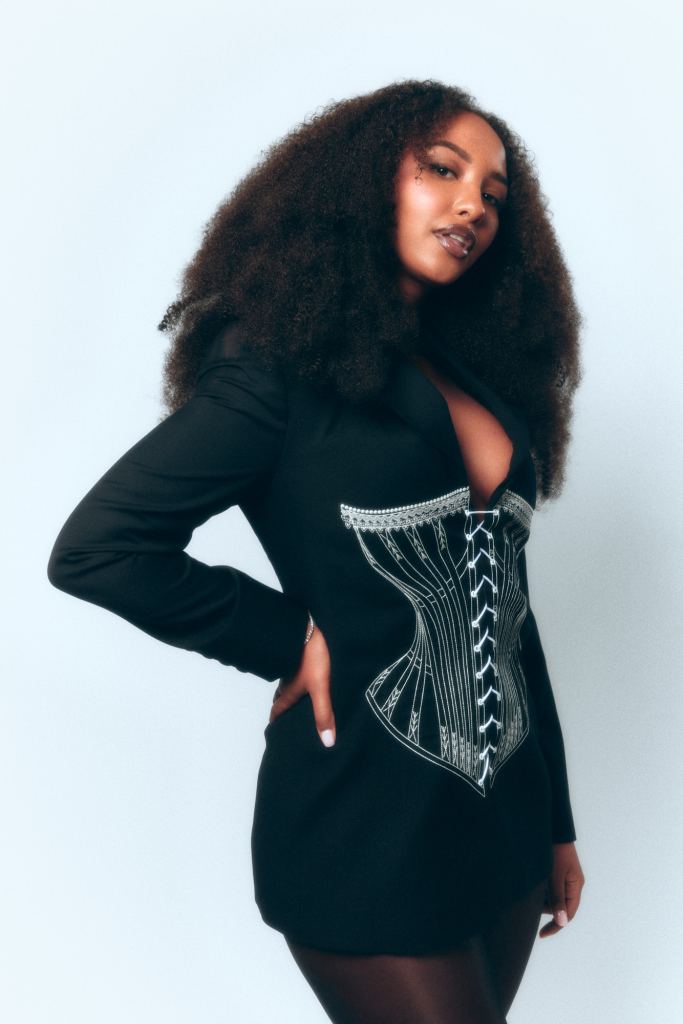
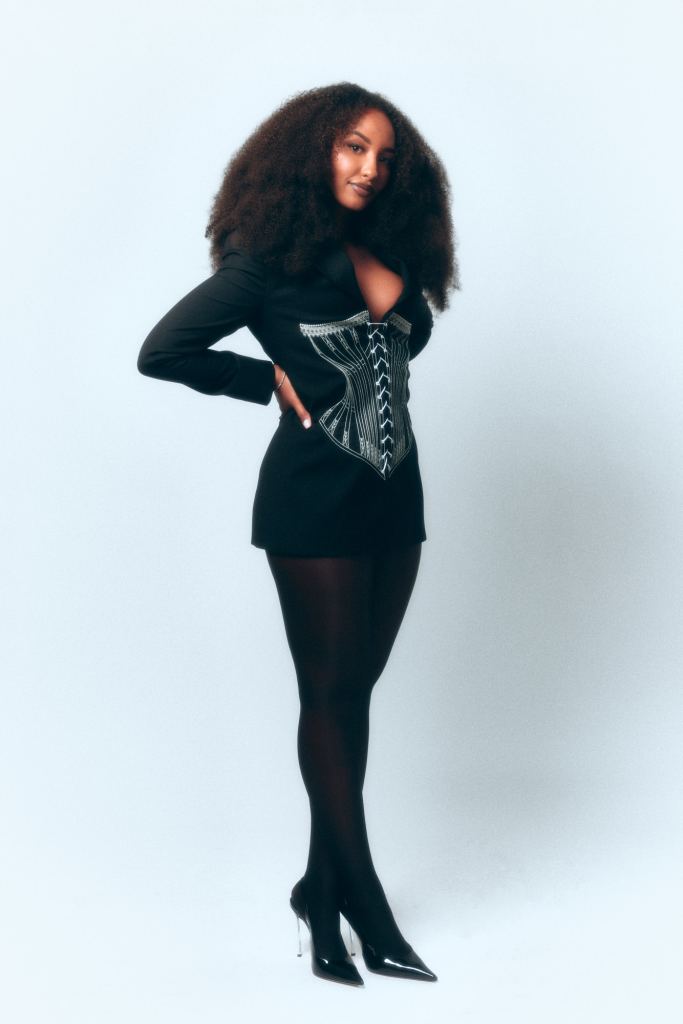
Blazer Seen Users / Tights Wolford / Shoes Casadei
That’s amazing! Is there a type of TV show concept that you would love to host, that you would love to see? It can be existing or non-existing yet.
It’s funny you asked that because my manager and I have been having meetings with production companies and seeing what the future holds. Because I have given a lot of my life to motorsports and I’m kind of not necessarily branching out, but now that I’ve got a solid base in that, and that’s a great foundation, I’d like to add other things to my profile that are outside of motorsport and slightly more lifestyle orientated. I’m already doing other stuff in sports, which is also nice. It’s really refreshing to have conversations with people who aren’t necessarily racing drivers, who aren’t necessarily in the motorsport world doing something that’s still competitive because I’m a very competitive person, so I always like to get into the mind of other athletes and understand what drives, pushes them. Personally, I most enjoy consuming documentary-style content. And so the question I’m asking myself now is, “Is that also the kind of content that I would really enjoy producing?” And I think it’s a little bit of an unknown territory. I think I would have to experiment in different areas to know what it is I really would like to do versus what I think I would like to do. So there’s one idea I have in mind, it’s still sports-related, but it’s just understanding the sacrifices parents make and the relationships that they have with their successful athletes’ children. I think there are quite a lot of really successful athletes out there today who have compromised relationships with their parents. It’s a political way to put it. And then you have some really successful athletes who have great relationships with their parents. And I would like to understand the psychology of that a little bit. There are two very different ways to nurture your kids. And the results can often be very different and sometimes similar. How do parents make that decision and how does it happen? It’s all very fascinating to me.
Oh, that sounds really interesting. I hope to see this documentary produced by you one day soon! So I read that you have been doing some stunts in films as well – What was that like?
It’s funny because when I first got the call, the first movie I ever did as a stunt person, as a stunt driver, was the James Bond movie No Time to Die. And obviously, when I got the call, I was mind-blown. I was like, “This can’t be real.” I was sure this was a fake. It wasn’t even a call. They had DMed me on Instagram, which is such a bizarre way to reach out. But that’s part of the reason why I thought it was fake because I ignored them for weeks. And then they reached out to me on my Facebook page, and then someone who I knew, who knew someone who knew someone, called me and said, “These people are trying to get hold of you.” And then I went, “Oh gosh, I’ve been ignoring them for weeks.” So that’s when I realised it was real. When I first went to the stunt coordinator, I’d said to him, “I don’t really know if I have the skill that you’re looking for because I don’t do stunts. I’m a racing driver. I can drive fast on a track, but what are you expecting me to do here?” They told me to audition, and do a few tests. I thought, “Okay, sounds straightforward.” In the worst-case scenario, I’m going to do the audition and be able to say that I auditioned and go home. But anyway, apparently, I had the skills they required. And they kind of did teach me how to drift because most of the tests were drifting tests and I hadn’t really drifted before. I mean, people just assume racing drivers can drift, but when do you drift as a racing driver? They allow you to do it at the end of the season once in front of the crowd, but it’s not allowed. I would never drift with my road car. So where would you learn that skill essentially? So yeah, they kind of taught me how to drift. I did a few tests, which is like holding a form of eight, like an infinity sign. So yeah, essentially in a drift, I had to drift to the infinity sign, which I managed to do, which was mind-blowing to me. And it was all very fascinating. I mean, it is like Hollywood is everything you think it is. Definitely nerve-wracking because like my first stunt on Bond, Daniel Craig was involved in it. So there was a potential that I would run him over and that is very stressful. Can you imagine? Can you imagine if that happened? They had been shooting a helicopter scene just before they were going to shoot my scene and the helicopter was up in the air and I was sitting in the car for literally an hour waiting and waiting and waiting for them to go call action and explain to me what I’m doing, and because the sun was setting, there’s a specific time of day they wanted to shoot it. If we didn’t get it in like two takes, then we were gonna lose the daylight. And so I was going, “Okay, okay, okay, okay, what am I doing?” Then we did the first take, for them to decide what speed they wanted me to do that and everything with a stunt double in his position. And then I remember them pushing the car back down the hill, I could hear over the radio, they said, “Okay, bring in Daniel. And my hands just started sweating. I was like, “Oh my gosh.” I was seeing headlines like “A racing driver kills Daniel Craig.” I was like, “Who put me in this position?” But anyway, I clearly didn’t kill him. Everything went smoothly. They invited me back. I did a few more scenes. And so yeah, that was really, really cool. I enjoyed it. I’m not doing any stunt driving at the moment. I still do get calls to do jobs but it’s very difficult with the Formula 1 calendar and movie schedules. The problem with the film industry is that they schedule something but it constantly changes and once you’re contracted, you can’t really back out of it. So I can’t unfortunately afford to take that risk because of my priorities which is broadcasting in F1. So I haven’t really been accepting any jobs unless they happen to fall in the winter period or something like that, but they don’t really tend to. So I’m pausing it for now, but it’s something I do what I would like to do in the future.
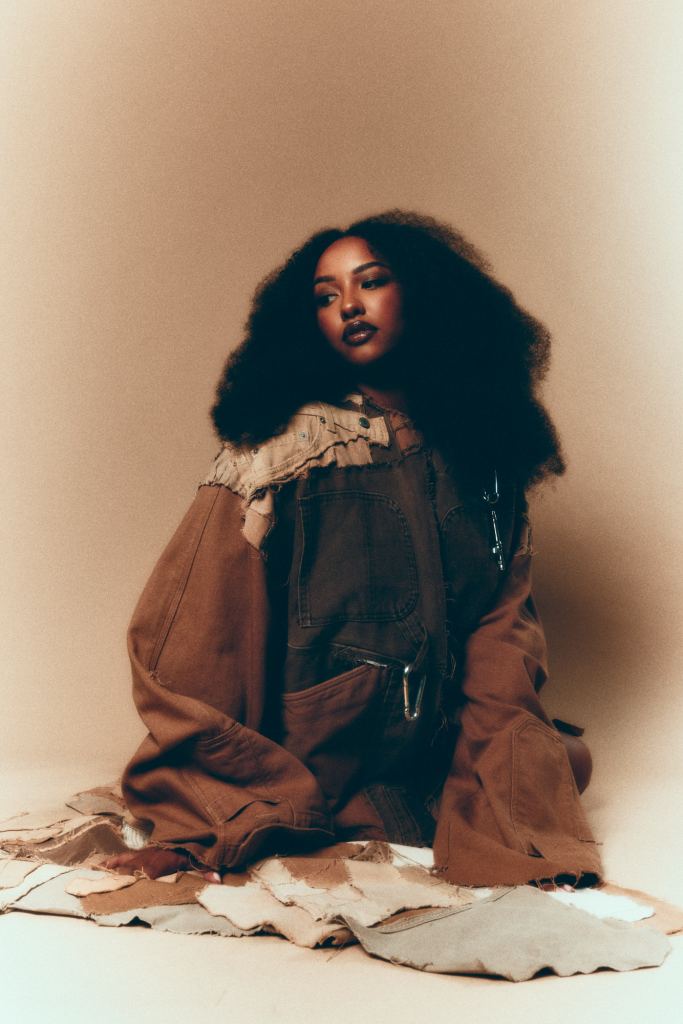
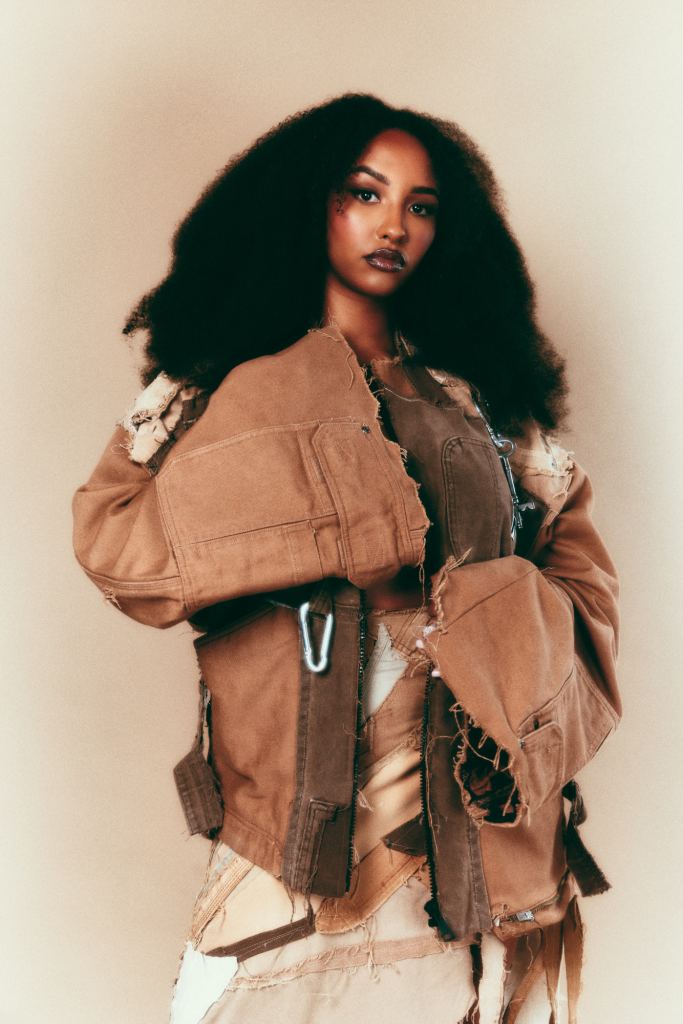
Full look Natasha Zinko / Boots Underground
That sounds terrifying, I would have shat my pants! So you obviously are so super busy, but outside of your career, what do you do to unwind after a busy day that has nothing to do with work?
If you have any tips, let me know. Um, I try to exercise. I think exercise is really good for me to calm my mind down. So if, and when I can, that’s how I do it. I also really love the sauna. I’m not extremely into meditation, but over the last, let’s say, four or five years, I have become more into meditation. I think the sauna is a great place to meditate because it’s usually really quiet unless people come in there and chat, which I don’t like at all, but I just find it’s 15 minutes at a time. That’s usually how I do it. And it’s just pure, pure quiet, like a bit of meditation, just calm your mind. That’s really what keeps me sane. But also people – people are what keeps me sane because it is a very busy life and you miss out on a lot of things and the world is always willing to tell you what they think of you, which is not always generous. And so I think it’s important also to surround yourself with people who support you and who believe in you and who remind you like who you are. I find it’s easy to get lost in all of it. I want to make sure I spend quality time with the people I care about, and when I say quality time, I really mean quality time because that’s something that’s important to me. I want to speak to the person, really enjoy time with people, like on a proper level. I love that because sometimes it can get so lost in the hustle and bustle of everyday life to have proper quality time.
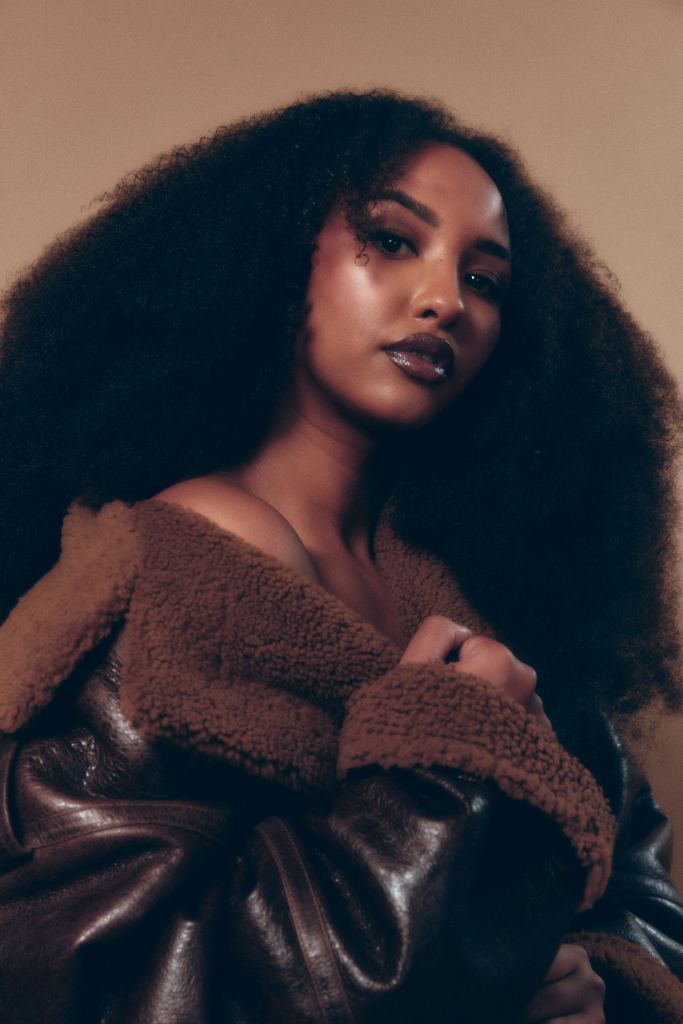

Coat Remain / Shoes Manolo Blahnik
That’s such a great approach to it because good quality time can be so hard to find! I love how you actively advocate for a more inclusive racing industry for women. What are your current thoughts about the industry so far and what do you still think needs to be done for a more inclusive environment for women in racing?
I wouldn’t limit it just to women because it’s not the only thing I’m passionate about. I think this really needs to have people from a more diverse background. And I used to be a diversity and inclusion ambassador. Inclusion includes things like sexual orientation and physical ability, and all these things are so important. And so I would like to see the industry change more in all of those aspects. I have to say, to be honest, I feel quite positive about where we are now, the direction we’re going in, and the way we’re traveling in a positive direction. Because if I look at the Formula 1 paddock today, if we’re narrowing it down just to Formula 1 for now, there are already more and more women in the industry. You’d be surprised how many women you do see in the paddock and that’s both from the workforce, but also from the spectators, from the guests of teams, all that, like across the board, there are more and more women involved in motorsports. We are in a much better place than we were many years ago. So there is a lot of focus on it. I think there are definitely a lot of people who are interested in this in the background, working hard to make sure that things keep moving in this direction and that they don’t just stagnate where we are, because it’s not good enough, but we’re definitely already in a much better place. And it’s an environment that I think any woman would be comfortable coming into. Only upwards! For example, it’s something that’s not been covered or people aren’t really that aware of it, but I signed a contract with Formula 1 last year as an ambassador for them. I asked them, “Oh, who were your other female ambassadors?” and they said, “No, no, you’re the first ever female ambassador of the sport,” which to me is a massive honour. To think of this being the sport that I dreamed about my whole life and to be their first-ever female ambassador is major news. But it also just goes to show where the industry is at, you know? I mean, they’re open to that kind of thing. And in my ambassadorial role for the sport, we focus a lot on making it a better environment for women. It’s a positive place to be in right now.
Incredible! Congratulations on being an ambassador too. It was so great speaking to you!