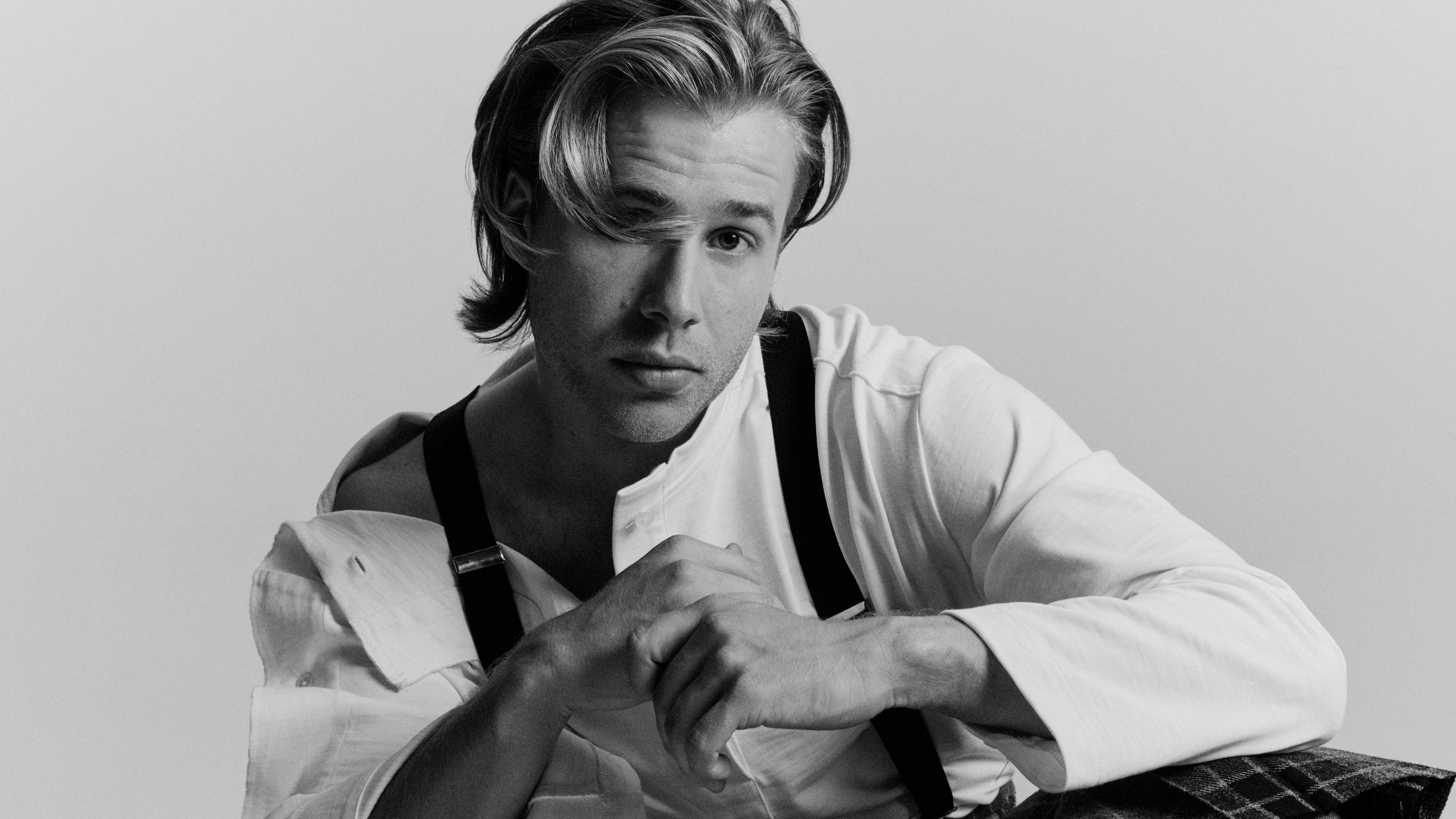
Patricia Highsmith’s transformative novel, The Talented Mr. Ripley, was published 70 years ago this November. Beginning on September 4, the psychological thriller will become an enthralling new stage production, adapted and directed by Mark Leipacher. Stepping into the spotlight as the enigmatic Tom Ripley is 26-year-old actor Ed McVey. Speaking about the process of embodying this iconic character, Ed said that his portrayal is different “from moment to moment,” and that the staging of the scenes “never allows Ripley, especially in the second half, to really breathe.”
It is this heightened sense of mania that will ultimately create an immersive atmosphere for those slated to see the show during its UK tour. The idea, Ed said, is to make “people feel like they are as in it as I am, and they are as a part of it as I am.” The way the play unravels itself creates room for preexisting notions about Tom Ripley to melt away from one scene to the next, which will hopefully inspire people to reexamine their perception of the source material. For someone who comes from a theatre background and who has a desire to connect with others over a shared subject, Ed is excited to undertake this task. He’s eager to continuously engage with his scene partners and to discover how each audience responds to the ensemble’s unique storytelling.
PHOTOGRAPHY
Annie Noble
FASHION
Shaquille Ross-Williams at LMC Worldwide
GROOMING
Kim Roy at One Represents
using Armani Beauty & Bumble and Bumble
LIGHTING TECH
Emma Pottinger
DIGI OP
Susie Brady
RETOUCH
Katy Sims
FASHION ASSISTANTS
Ahmad Alek and Pav Nagra
During our exclusive interview, Ed closely examined Ripley’s psyche and motivations, and discussed what it’s like to embody someone who oftentimes doesn’t really know who he is. He also spoke about why he thinks Patricia Highsmith’s story remains deeply relatable, and he shared the one thing he wished everyone did when attending a theatre performance.
Our conversation was illuminating, and it helped lend perspective to the play’s tagline: How far would you go to be someone else? Ed McVey is willing to go as far as stepping into the shoes of a fictional sociopath for a two month run of shows. Tom Ripley, though, is willing to go even further.
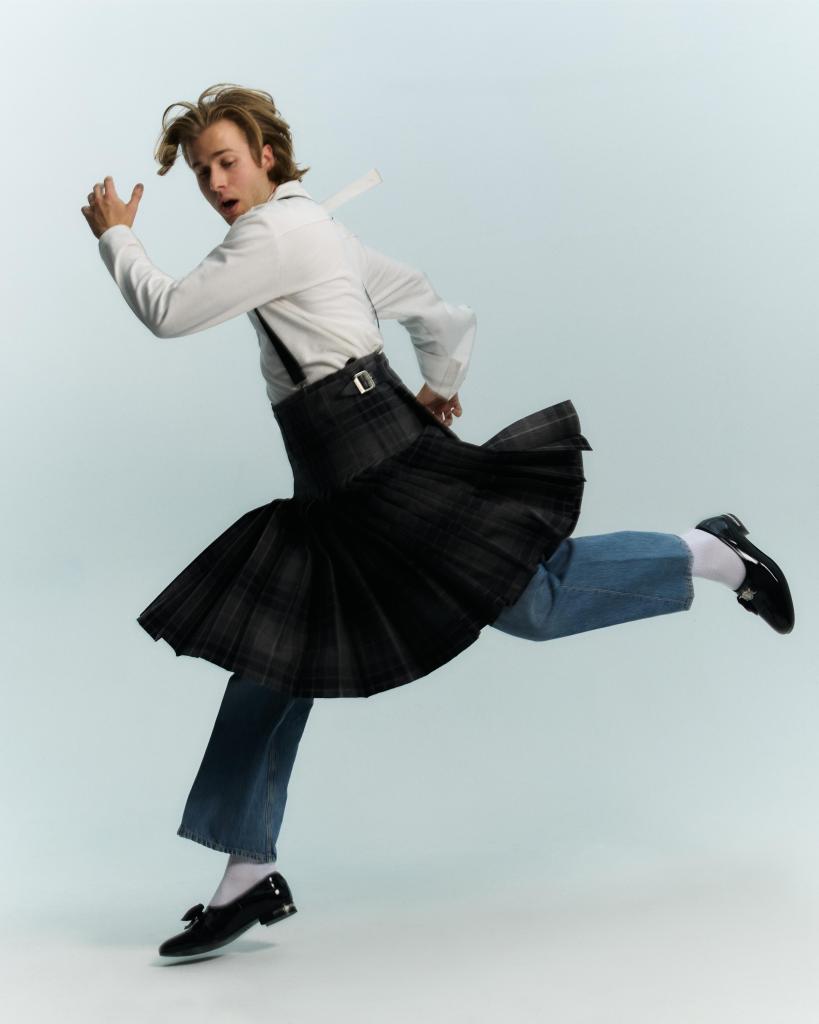
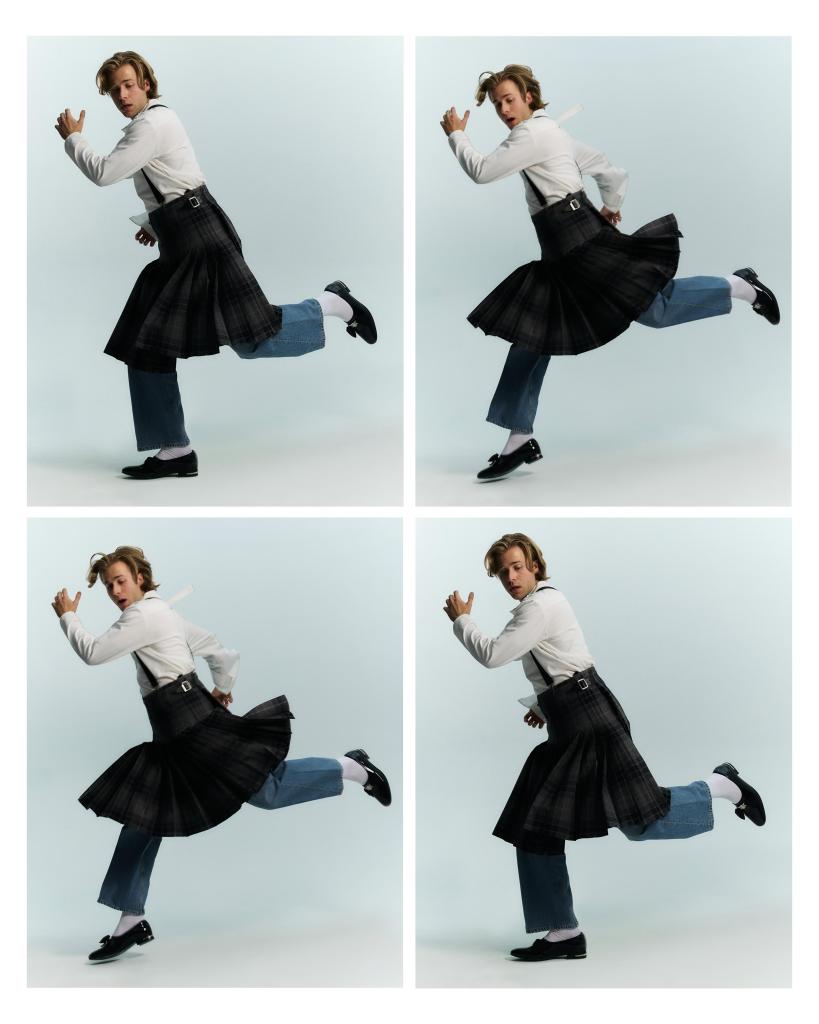
Top Yuhan AO / Kilt Le Kilt / Jeans COS / Shoes TOGA / Suspenders and socks Stylist’s own
How are you?
Busy! But good. We have our first preview in a week, so it’s crunch time, but we’ve just done our first run-through, and that was amazing. Everyone’s really getting along well, and it’s nice to be back on stage.
That’s all you can ever really hope for—that everyone is getting along and things are going at a good pace.
And also, just the show as a whole, and as a piece of writing, is everything you could hope for it to be from the perspective of acting on stage. It’s got everything I could want in a play that I’m doing, which is great.
I’m very excited to talk to you about all of those things. Oftentimes, the staging of a play can feel like a character of its own, which feels particularly true for this production of The Talented Mr. Ripley. I know you’re still in the rehearsal process, but how has the staging of the production influenced the physical aspects of your performance?
I think the way we’ve staged it and how it’s written, there’s no air in between anything. The scenes attack one another, and they never allow Ripley, especially in the second half, to really breathe. And that is purely because of the staging. I’m constantly getting thrown from one scene to another and having to put out fires and deal with everything all at once. And I think that’s true of the first half as well. We go through so many worlds—worlds that are built and then they dissolve as another thing is born and another thing dies. It should feel like a rollercoaster for the audience. We want people to feel like they are as in it as I am, and they are as a part of it as I am.
It sounds like it’s really immersive, which must be thrilling, but I can’t imagine trying to balance that mania where all of your senses are heightened and you don’t have any breathing room to reset between each new scene and location.
You’ve got to do all your breathing before the show starts, or during the interval, which is challenging, but it’s the right way to tell it. I think if it were really slow, and meandering, and soft, and airy, then it loses all the stakes of the story.
Totally. As a viewer, everything is at a fever pitch from the beginning because you understand Tom Ripley’s intentions and where they might lead, and you get all of these background clues that the characters you’re interacting with don’t know yet.
And I think what’s interesting is that people will definitely come in with certain judgments, I suppose, or a certain preexisting understanding of who we think this person is. But we’ve come at it from a slightly fresher perspective in trying to see why someone might do these things, or where someone might be coming from, or the motivations behind these decisions. Hopefully, people can connect to the reasons why, and not necessarily Tom’s actions…Well, I hope not the actions [Both laugh]. But hopefully, people can understand the motivations of why someone could be driven to do such things, and maybe won’t be too judgmental of him as a result of that. And again, that’s all down to the staging, and how it’s written, and how it’s developed and changed for the stage.

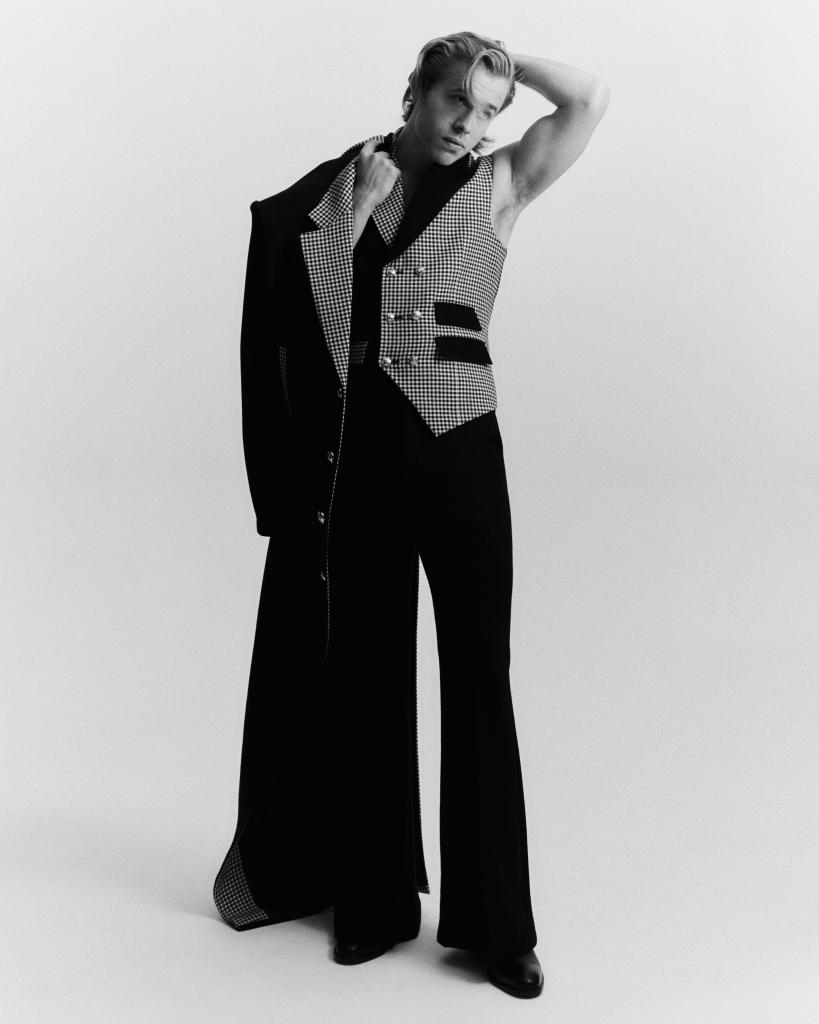
Full look Helen Anthony / Shoes Roker
You’re already touching on so many of the things I was curious about with this production. Tom’s actions, like you’re saying, are prompted by his perceptions of class and identity, but that morphs into an obsessive desire to access a lifestyle that isn’t available to him before he meets Herbert Greenleaf, which then creates a domino effect. I’m interested in how those themes are still so widespread in our world today, despite the fact that Patricia Highsmith’s novel came out 70 years ago. Do you think it’s this reflection of what it means to struggle with who you are versus who you want to be that still makes the story feel so relatable?
Wow, amazing question. Thank you for asking that. Well, I think the old phrase of, “The grass is always greener on the other side,” still persists. People always want what they can’t have, or they’re told that they shouldn’t have, or that they’re not allowed to have. And that’s true for Tom. He doesn’t understand why he can’t have this life. What’s the difference? It seems that only money is the difference between him and having everything he could ever want. People very much have that, or can have that, point of view still today. I feel like everything always comes around to social media eventually, but people having a lifestyle thrust in their face through that, and we’re now in the social media age of comparing yourself to everyone else, and more frequently seeing constant displays of wealth. And I think that was true of 1955 New York as well, during this post-war revolution of industrial power and money coming into the country. It was a very prosperous time for the U.S., and things were booming; skyscrapers were popping up left and center. The wealth divide was becoming quite specific in New York. Tom Ripley is around all of that, and he doesn’t understand why he can’t be a part of it. And through this background, he has, he wants everything now, and he wants his life to change now. I think a lot of people can connect to that—a lot of people can relate to wanting things now, and not wanting to wait to have them. There’s a lot of this quite high-intensity, high-need craving lifestyle today. I think that’s how Tom feels, too. Why should he have to wait if other people have it now? And he’ll do whatever it takes because he feels like that will solve all of his problems.
Unfortunately, it creates more problems, and deeper problems, that are harder to escape than his original impatience would have been. Another piece of what’s driving him is his desire to transform into a different version of himself. The tagline for the play is: How far would you go to be someone else? And I was curious because, as an actor, you are in essence going to great lengths to be someone else for a little while, though you’re doing it in a much healthier way than Tom Ripley is. What interests you the most about temporarily being someone else through the roles you’re playing?
For me personally, and I think this probably relates to Tom as well, I don’t think there’s any feeling like that of connecting with another person over a shared subject and carrying the same goal together. And when you know that someone is really listening to you, and you are really listening to someone else, and you get to say amazing words and feel all of these things, you feel full. I feel full. I feel like nothing else exists, in a way. And I guess it is escapism, but I feel very present. I feel like I’m here and I can’t be anywhere else. That is such a nice feeling to be present and to be with someone like that. And that can be with an audience, or with someone else looking into each other’s eyes and knowing you are both there in that moment, nothing can break that or stop that, which is a wonderful feeling. And in regards to Tom, I think his does come from a sense of escapism, where he doesn’t feel worthy as himself to exist in this life. So, he feels as if he puts on this character, then that character is allowed to exist fully. He feels comfortable. He can look in the mirror and see someone else who deserves to look in that gilded mirror, in a sense, whereas Tom Ripley wouldn’t, which is fascinating. But that likely comes from a deep trauma, and a deep-seated self-hatred that he harbors, which definitely roots more in escapism, and in wanting to have a new skin that is allowed to exist in this beautiful world.
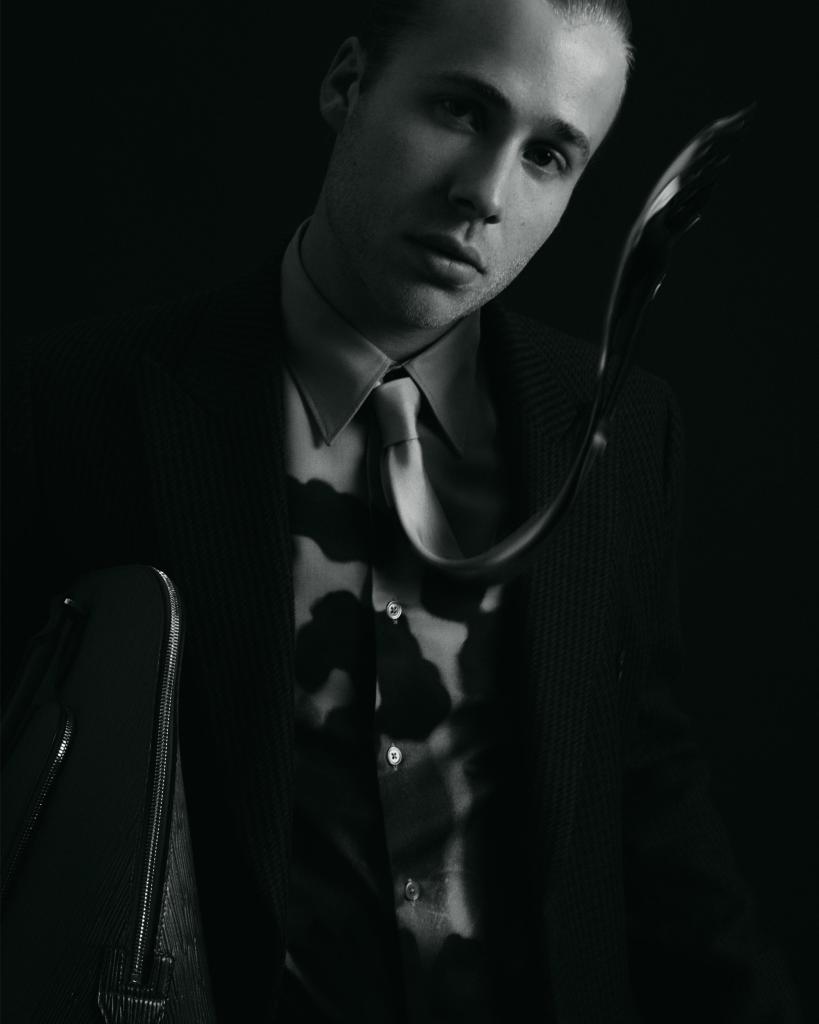
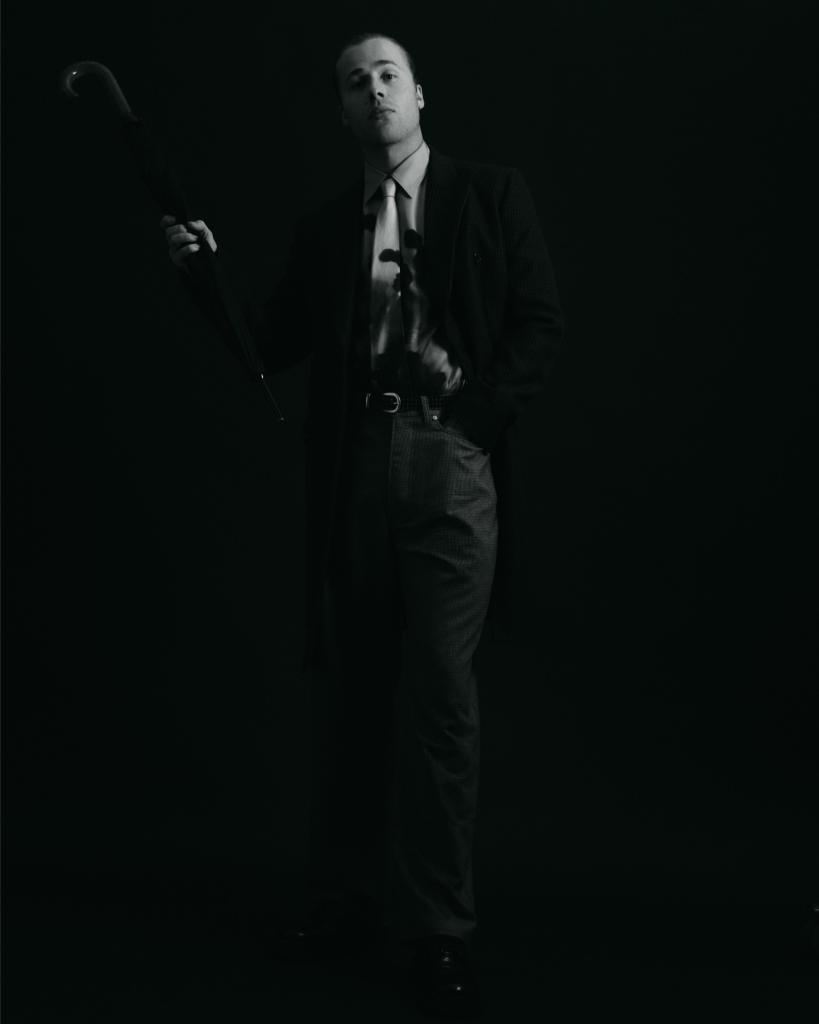
Full Look Paul Smith / Bag Mont Blanc
That was really beautifully said. And also, I never even thought of that—of how acting can be a way to access being more present, because you have to be completely locked in. You can’t be thinking about anything else because you’re trying to remember your lines, and your stage blocking, and you want to be a good scene partner.
Absolutely. Like you were saying, being a good scene partner is the most important thing. Putting all your attention on the other person is helpful for everyone involved. I very rarely know what my line is in those moments. Someone will say the cue, and then I’ll be like, “Oh yeah, that’s what I’m supposed to say.” [Both laugh]. But it’s hard to try and remain that focused sometimes. So, that is the challenge and the joy of it when it happens, and when you get into that flow state? There’s nothing better than that.
I hope you’re able to exist in that flow state as much as possible throughout the run of this. You’ve touched on this quite a bit in your answers so far, but I’m intrigued by Tom as a character because there’s such a complex duality to him. He’s outwardly presenting as one way, which is in direct contrast to the turmoil he’s experiencing inwardly. As you’re approaching that duality as an actor, are you looking at him as two separate characters? Or do you want one part of him to inform the other to create a more cohesive portrayal?
In terms of what we’ve been working with, and what I’ve been working with, he’s different from moment to moment. He’s such a social chameleon. It’s a defense mechanism to do that, and to adapt himself to any situation realistically. You can put him anywhere and he’ll be uncomfortable for a minute, but then he’ll figure out what persona he needs to be to survive the evening, and then he’ll get out of there. So really, it is just being present moment to moment—what is needed in this present time. It’s interesting that the idea of his sense of self is really strong one minute, and then the next minute, I don’t know if he even knows who he is, and he’s trying to figure that out through external means. He is just aware, and alive, and is trying to survive, and he’ll do it by any means necessary. And he’s just trying to figure it out, like the rest of us are.
Which is hard to do. I often joke that I’m surviving, not thriving, because I think sometimes you very much get into that habit of being like, “I’m just in survival mode.”
Definitely. And Tom is in that from the start. He’s just surviving the whole time.
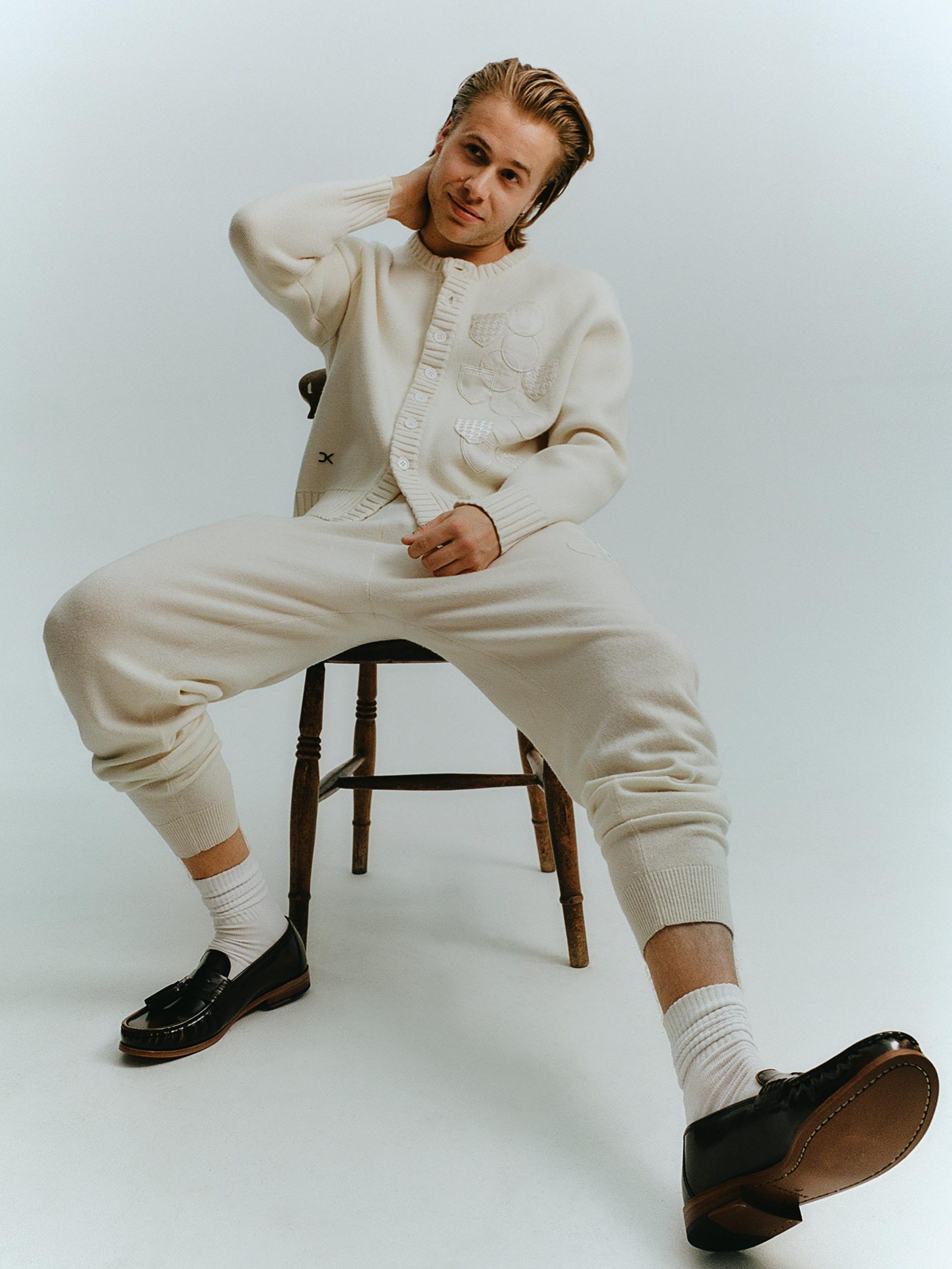

Full look and briefs David Koma / Shoes Grenson
That must be intriguing to live inside someone’s brain and skin that is thinking like that and processing things to that degree.
It’s a lot of brainpower as an actor, but Tom is seemingly wired that way. His brain is working very quickly all the time, and has had to work that fast for a very, very long time. When he comes up against things that he can’t understand or hasn’t felt before, he either acts out or tries to wrangle it in that moment. I think when you come see this show, if you can see the show in the U.K., I hope you’ll see someone who hasn’t got a plan; he just knows he wants something, but he has no idea how he’s going to get it. It seems an impossible task. And then dominoes keep falling, and he keeps trying to figure out his next move after that. I think what’s going to be exciting for an audience is that they shouldn’t know where this is going to go, but they’ll know that none of this is premeditated. All of it is completely on the fly, and it could go wrong at any moment. And I think his brain thrives on that quickness. I think he likes to feel “on.”
I would imagine that adds to the stress and pressure he’s constantly experiencing, which will then be felt by the audience.
We’ll see what the matinees are like. [Laughs].
It’ll be interesting to see the differences between the audience’s reactions on the tour!
That’s what I’m excited about with the tour aspect of going to different venues, is seeing what different audiences react to, what they don’t react to, what they find funny, what they don’t. That’s really interesting to me because I’ve never done that before [toured with a production].
I have zero experience as an actor, so I’m always interested in learning about the technical aspects of the job, particularly when speaking to someone like yourself who has worked in theatre and on screen. How does the medium, like a play or a television series, impact the way you interact with the director of a project?
Oh, I think that depends. Mark Leipacher, who’s our director here, comes from ensemble theatre, and he’s good at making groups of people come together to create a unique project. He works with his actors, not at his actors. To be honest, I’ve been very lucky. I haven’t really experienced a director who works with their actors and tells actors what to do and to just go do it. Mark is very much of the mind that we are creating this thing together. And he’s already played the play a couple of times before, and he’s the adapter of the story, and he’s very keen to not do a revival of something he’s done before. So, we are building the thing from the ground up as if it’s never been done before. And it makes you care about it in a different way. It makes you feel a part of the show in a different way. It makes you, as an actor, feel like you’re in the bones of this thing. It’s not just like, point and shoot, stand there, say that, move there, say that. It feels like you are baked into it. That’s been really important to me. I prefer a director who is open to working something out together. Obviously, with film, there is a time pressure, so sometimes you’ve just got to be told what to do, which I also respect because we’re losing the light and those sorts of things. But having a director who sees you as someone who’s building the thing with you, and not as simply another cog in the machine, and is working to build something with you, is amazing. And that’s how Mark is, which is really nice.

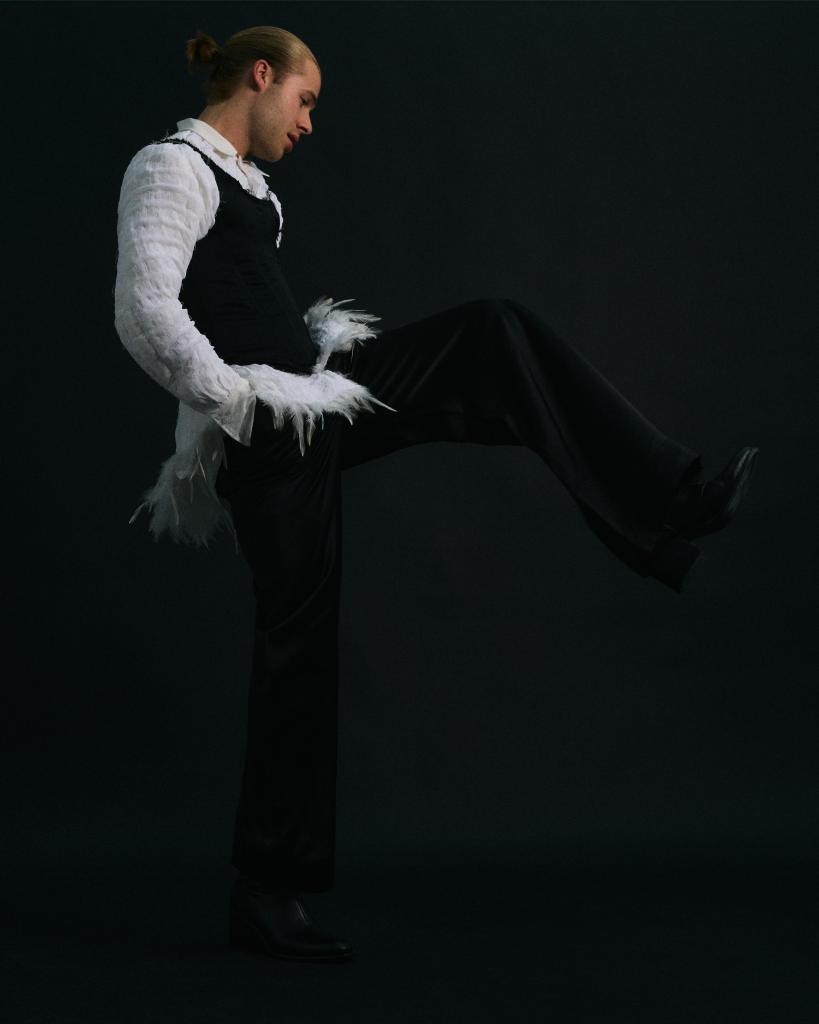
Full look Daniel Fletcher / Shoes Roker
It seems like you’re able to approach it in a meaningful way because it’s so collaborative, and that your opinion, or your take on your character, is valued, and that Mark is taking that into consideration in the greater scheme of things.
I definitely feel very valued and heard, and everyone’s best idea wins is the kind of mentality we’ve been operating under.
You previously worked as an usher at London’s Playhouse Theatre, which I feel like has given you the unique experience of interacting with audiences in a multilayered way. As you’re gearing up for The Talented Mr. Ripley, what’s one thing you wish everyone did when they were attending a show?
Turn off your fucking phone! [Both laugh]. Turn off your phone, please. That’s my main one. That one really gets to me as an audience member as well. When I’m watching plays and a phone goes off, I’m just like, “Oh my God, come on, we’re all here. It’s okay. It’s fine. Just put it on airplane mode, or put it on silent.” That annoys me.
I completely understand that. When you were envisioning yourself as an actor growing up, did you picture yourself most often on stage or on screen?
I admired the screen so much—all of my favorite performances were on screen. I never really went to watch theatre much when I was a kid. I saw my first show when I was probably 13 or 14, and I was blown away. I think my dream as a kid was to be on film sets, but that always felt really far away, and my only form of acting at that point was theatre. So, I always thought that if I could choose my path, I would probably do theatre and then hopefully out of theatre would go to screen. It ended up being the other way around in the end, and I found myself on a big set for the first time, and I was quite overwhelmed. But pressure makes diamonds, as they say, although I suppose we’ll see about that. I’m just lucky that I get to do it in general. A lot of actors say that, but it is true. It’s really hard to work in this industry, and to be able to do it and to do something as meaningful as a project like this one is great. I’m open, though, to whatever comes to me, screen or stage or voice acting.
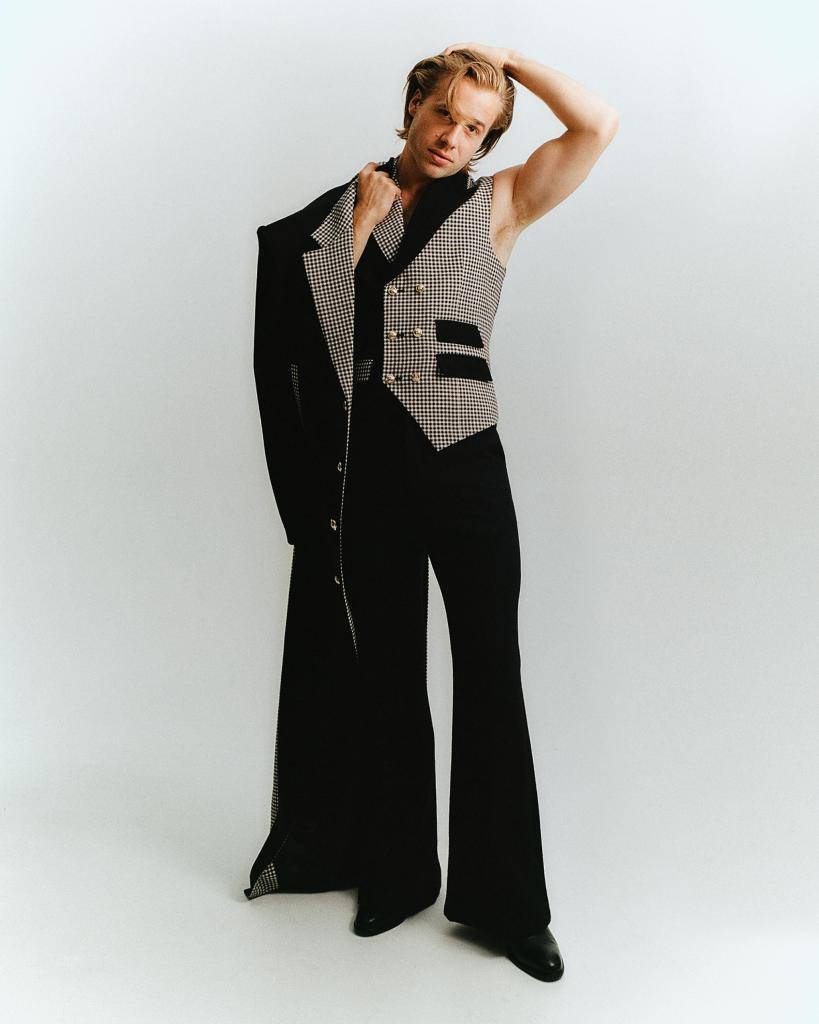

Full look Helen Anthony / Shoes Roker
I think that’s a great approach to have. I’ve always believed that things find you when you’re ready to receive them, and if you stay open to that, you’ll be able to receive things in the exact moment they’re meant to be part of your life and your career.
Yeah, I agree. I really agree with that.
Finally, I always like to end with a fun question. I read in a previous interview that you’re a Star Wars fan. So first, can you confirm or deny that?
[Laughs]. I can strongly confirm that I am a Star Wars fan.
Perfect! If you could choose one Star Wars character to befriend Tom Ripley and potentially lead him down a different path, who would you choose and why?
Oh my God. Well, fuck, that is a crazy question. [Both laugh]. I think he probably would eventually turn to the dark side, even if he started as a Jedi. I think he would end up defecting at some point. Are you a Star Wars fan?
I am, yeah. So I’ll understand whatever reference you’re about to make.
Okay, cool. I think I could see him being an apprentice of Count Dooku. And I could see the journey of Tom originally being a Jedi, and Dooku as his Jedi master, and then Dooku turning and taking Tom with him. I think that could be amazing. I can see Tom with a red lightsaber. But I’d also like for him to have met Qui-Gon Jinn and to just be around a good guy who could take him down a righteous path. I could also see someone whispering something in Tom’s ear, though, and him thinking about how the grass is always greener on the other side, and maybe he could have more if he were over that side, so I could see him defecting, for sure.
Qui-Gon Jinn was my initial thought, but then I thought that would maybe send Tom down a similar path as Anakin, who was supposed to be guided by Qui-Gon, but obviously ended up being guided by Obi-Wan instead. Which, you know, Obi-Wan was doing the best he could.
He really was doing the best he could.

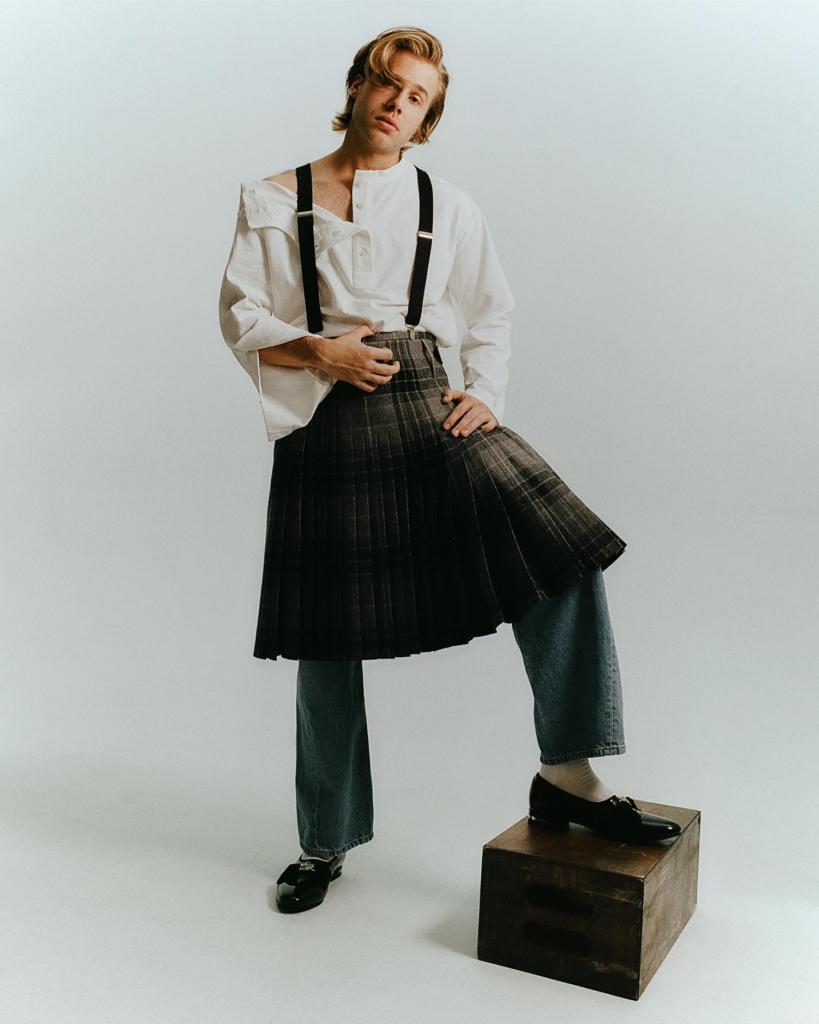
Top Yuhan AO / Kilt Le Kilt / Jeans COS / Shoes TOGA / Suspenders and socks Stylist’s own
But technically, he inadvertently becomes the reason why Anakin ends up the way he does, because Obi-Wan tries to avoid sending him down that path, and his avoidance is what ultimately causes it to happen. So, maybe if Qui-Gon lived, he could lead Tom and Anakin down the right path.
I don’t know, I feel like Anakin and Tom would be an interesting pairing…
[Laughs]. On second thought, maybe we don’t want them in the same room as each other.
They’ve both got their stuff with their parents, and they’ve got things they need to deal with and not necessarily take out on everyone else. But I think we’ve got some good theories.
I think so too. Is there anything else you’d like to share before we wrap up?
Anyone who reads this, come see the show. Please come see it. I think it will be interesting, fun, and exciting. Have you seen the pictures for this?
Yes! I was looking at the promotional stills earlier, and I saw some of the videos that were posted on Instagram showing what the stage will look like. As soon as I saw those, I immediately wished I could go see the play.
The plan is to go to the West End eventually, so hopefully you can see it when we go over there. I hope whoever’s reading this comes to see it. I think it’s going to be really good.
The Talented Mr Ripley is now on tour around the UK. Visit TheTalentedMrRipleyPlay.com