Harrison Osterfield is interested in the art of storytelling. Whether it’s in the literal sense of bringing a story to life on stage—like he’s doing alongside Maia Novi and the cast of Invasive Species—or through an unexpected medium like beekeeping, Harrison’s always in pursuit of this goal. He’s partially driven by his general inability to relax, but the primary force behind his professional endeavors is a genuine desire to be creative. In Invasive Species, he’s had the opportunity to unlock his creativity in new ways. He’s also tapping into his drama school roots to access skills he may have previously thought were unavailable to him.
PHOTOGRAPHY
Adam James Richardson
FASHION
Celine Sheridan
GROOMING
Sandra Hahnel at Caren Agency
using STMNT Grooming Goods
Playing multiple characters with different energies and accents throughout the run of Maia’s hit dark comedy has inspired Harrison to let go and lean into improvisation. He admits during our conversation that improv terrifies him, but he’s having fun with it anyway. This approach “means each show is slightly different,” which allows for a deeper connection with the audience. Given that the front row is essentially on stage with the cast, maintaining this connectivity and transference of energy is one of the things Harrison finds most gratifying about this particular project.
In addition to chatting all things Invasive Species, we discussed Harrison’s preparation process, the art of making the perfect playlist, what book he’d like to adapt for the screen, and a potential business venture involving honey.
During a previous interview you did, where you actually spoke with a friend of mine, Sydney Bolen, you mentioned that you enjoy the rehearsal period that comes with doing a play because it gives you more time to lock into the material. How did the rehearsal process for Invasive Species help you prepare for, and settle into, the different characters you’re playing?
I’m glad I was being honest in that interview. [Laughs]. That’s exactly what I was most excited about for this job. We had about three weeks of rehearsals where we were able to unlock the text together. This show is so energetic and frantic in its characters and storytelling. You really need to know all about the text and about the characters to dive into it fully as an actor. So, having that time to get it into my body for this rolling list of characters was really important. I’ve loved having that rehearsal period, and it’s different to being on set where they’re like, “We’re going to shoot it on Monday, and you get four shots at it, and that’s it, and you won’t see it for a year.” This is a completely different experience, and each show has been different as well.


Vest Calvin Klein / Jeans Levi’s
That must be compelling to have a more immediate sense of gratification from it, as you’re saying, where you’re processing the experience in real time versus the delayed gratification you feel when you’re waiting for a screen project to come out.
It’s been very positive so far, which has been nice. And each audience provides their own interpretations of the text, and you can feel the energy shift with each performance. Getting that immediate feedback from the audience has been really exciting.
That was one of the things I wanted to ask you about because the show is very intimate, and the front row is basically on stage with the cast. What’s it like to act in such close proximity to the audience? Are you paying attention to their reactions, or are you separating yourself from them as much as you can to focus solely on your performance?
It’s very humbling. And it’s great because it’s a show that gets the audience immersed in the action, which means you have a relationship with the audience through comedy and satire, and also on some of the deeper topics at the same time. I think because it’s an intimate space, there’s a connectivity there where you can feel the energy between everyone in the room, and it all feels like you’re on a crazy train together for 80 minutes or so, which is amazing. I haven’t been on the audience’s side, but it feels like you’re doing it as a team, and you’re inviting them into the story—you’re thrusting them into the storytelling the whole time.
That seems like such a unique way of framing this production. When you’re performing it and living through it, you must take the audience into consideration to a degree, I would think? While still being mindful to divorce yourself from them so you aren’t reactive to their reactions, because you still have certain things you need to accomplish.
I’ve learned how to do that through sight lines on set. I can be quite good at making sure I don’t really focus on camera placement, and most people don’t get in the way of your eye lines, but sometimes you do have to tune them out as well. But when you’re doing a piece of theatre like this, you have eyes everywhere, and you’re trying to keep locked on the character while ignoring everyone laughing or reacting to things in the moment. So, it’s been a definite learning curve doing this type of theatre.
I’m overwhelmed on your behalf. [Both laugh]. I can’t imagine trying to not be reactive—other people’s laughter always makes me laugh for some reason.
I’m the same. I’m the type of person who wants to join in with the laughter, and then I have to remember I’m on stage and I’m supposed to be the one making them laugh.
You touched on this briefly, but I wanted to ask, because you’re playing multiple characters who have different accents, is there a trick you’ve found helpful in terms of reminding yourself from moment to moment who you’re supposed to be?
I don’t really have time to think about it, to be honest, because the changeovers are so quick. I think some of the changeovers are, at most, 15 seconds. So, you really have to switch on from the beginning, and that’s why the rehearsals have been great. I’ve been able to get into my body more, and there’s certain physical characteristics that I’ll implement just before going on stage, but once you’re out there, you’re at the mercy of the work you’ve put in beforehand. It feels like you can just go with it, because you don’t really have time to think. But it’s been fun to do these different characters and be really playful. I’ve missed being able to have that experience on stage where you’re playing with the audience and playing with the characters, and you can be overtly energetic. And then you have to remember, “Oh, I’ve got to do this 36 more times now, I should reserve my energy a little bit.”
Like a marathon runner. You can’t expend all your energy at the beginning; you have to pace yourself out.
I’ve just done the first week, and it went well, but I’m trying to remind myself that we’ve got four more weeks to go and roughly 34 shows, I think.
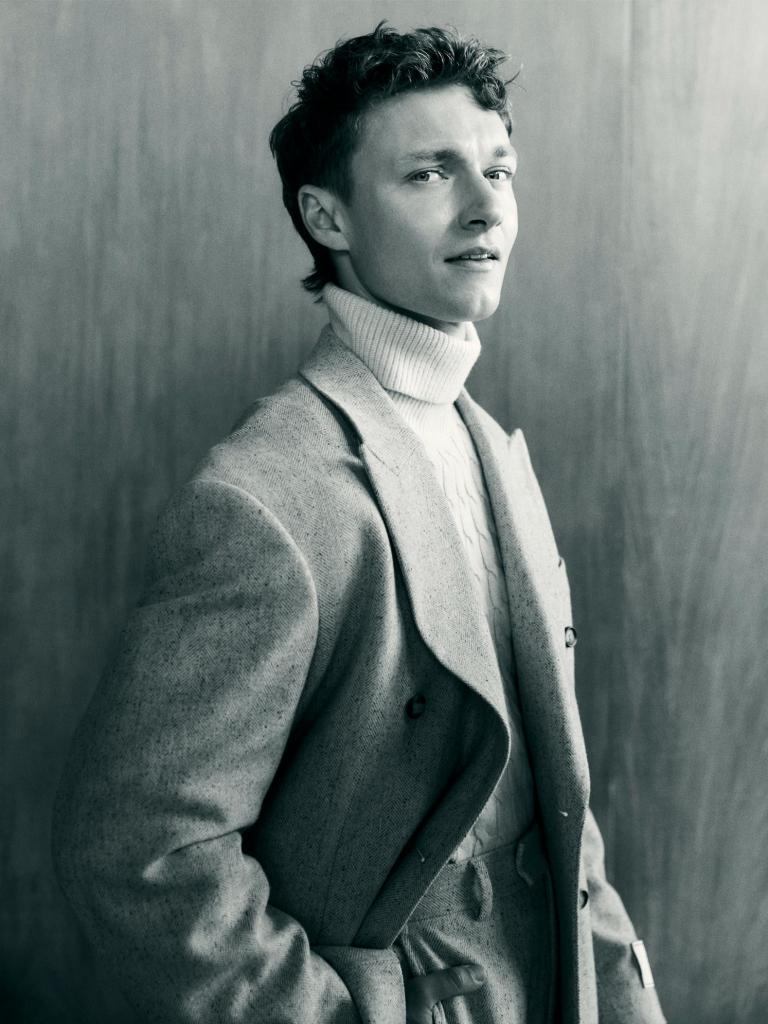
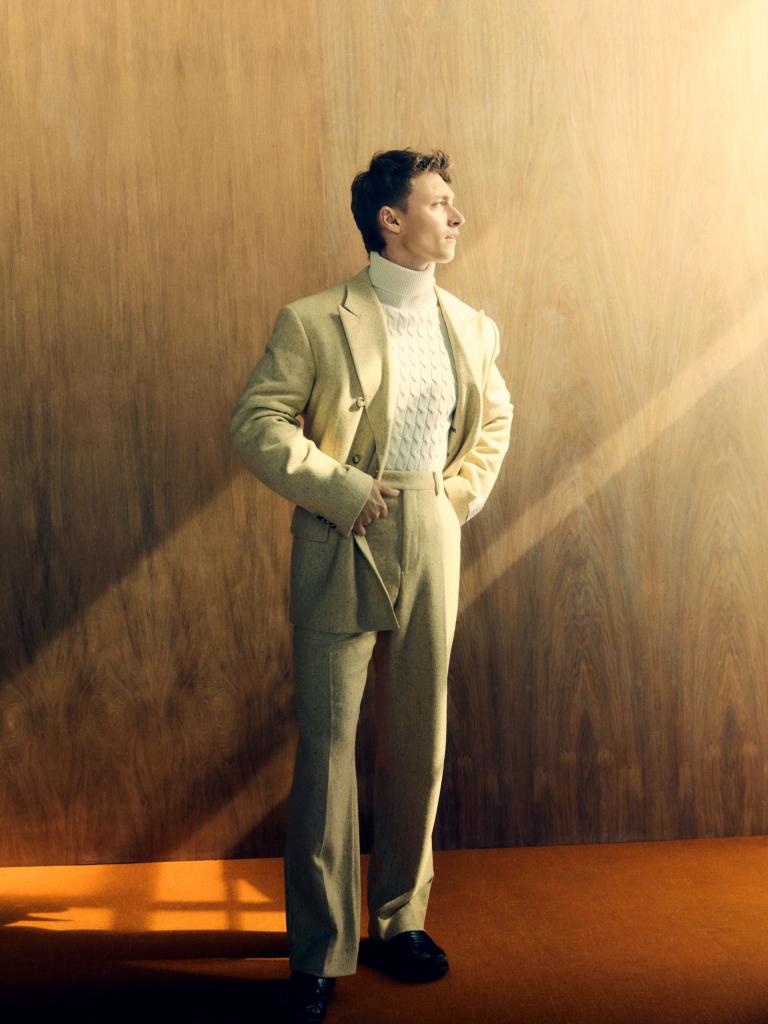
Suit and rollneck Gant / Shoes Grenson
That’s so many shows in such a short amount of time! Especially when you’re embodying several different characters and living in their skin each night. Well, are you doing it every night? Or do you have certain days off?
I have one day off on Mondays, and then the rest are every night. Plus, we’ve got two shows on Fridays and two shows on Sundays. So, eight shows a week.
It’s very much just your life for the next couple of weeks, then.
But then a photoshoot like this comes about and you’re like, “Let’s do that!” And I’ve completely forgotten I have a show tonight, but it’ll be fine.
You’ll lock in when the time comes. Is there something specific that helps you do that prior to showtime?
I listen to a music playlist that represents some of the characters I play, which gets me into the right headspace, and I like to get there an hour beforehand and do a vocal warmup. That’s something I hadn’t done in a while. Being able to fill the space with my voice it’s much different from being on camera, where it’s very minimal and you can be as quiet as you want because you’ve got a microphone to pick up what you’re saying. On stage, you’ve got to really project your voice. It’s been a good learning experience on how to do that and how to prepare for it properly.
You’re probably tapping back into your drama school roots and being like, “Okay, what did I maybe forget and how can I incorporate that now?”
Exactly. It’s those drama school things where, at the time, I felt like I would never use them again. And now I’m like, “Let me get my old drama school notebooks back out and do a 30-minute breath exercise.”
It’s great that you’re able to draw from those previous lessons! The premise of Invasive Species is based on Maia Novi’s real-life experiences. As you’re starring alongside her, what is most important to you in terms of how you’re portraying this particularly difficult time in her life?
I think the amazing thing about working with Maia on this is that it’s an honest experience she’s sharing with the world, and with the other castmates, and being able to speak with her outside of the rehearsal period and delve deeper into her story has been really important. Especially since the characters are based on real people as well. It’s unlocked a whole other type of research for the job, which has been very, very rewarding to have. She’s been so open and honest, and some of the subject matter is quite vulnerable. She couldn’t have been a better castmate and producer in a way that’s helped all of us, as a cast, get through this and give the most honest portrayals of those characters, while also pushing them to be what they are in the play.
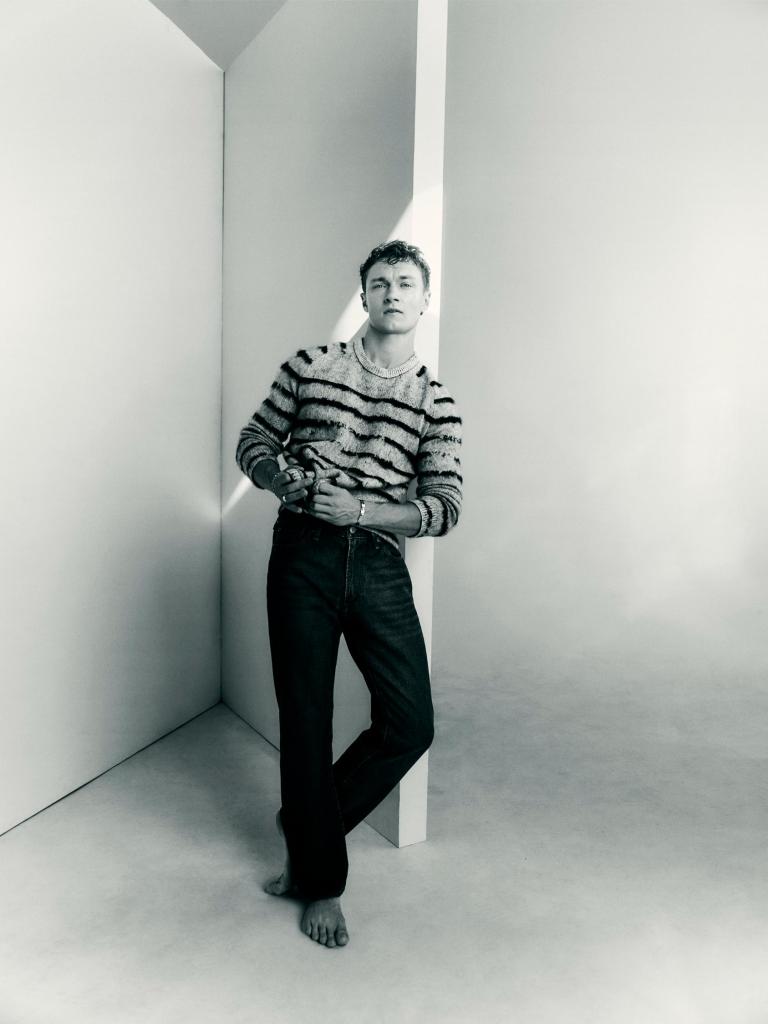
Jumper Balenciaga via Designer Exchange / Jeans Levi’s / Jewellery Harrison’s own
That must be such an interesting experience for her to be so candidly vulnerable like this. I know prior to running in London, Invasive Species was really successful in New York, so I’m sure she’s probably had time to live with that and accept that.
Absolutely. And she said how nice it’s been to have a new cast of people coming with new ideas and building on old tropes, while also introducing new ones at the same time. It’s been a melting pot of ideas and energy, and creating something that’s different from the first iteration of it, but still has the spirit of the show at its heart.
Was that gratifying on your end to feel like you had the space to come in with your own ideas and to have your own interpretation of it, while being respectful of what Maia created?
Definitely. It’s been like a circus where you can come and bring your own skills in and test things out, and some of it might not work, but some of it’s a new angle, or a new perspective that she hadn’t thought about before. And then to build on that and to create something really unique has been special for all of us.
Was there something you brought to the table that you’re especially proud of?
Nope. [Both laugh]. Let me think. Each character has had its own thing. To be fair, there’s one character, the British director, and a lot of the performance now involves quite a bit of improvisation. Beforehand, it was written in a certain way, but Maia has enjoyed the interpretation I brought of the character, and we do a lot of improv together during those scenes. It means each show is slightly different, which is quite fun. It’s in our bodies and minds to have these checkpoints in the script, but we can be free and playful around it. And that’s where a lot of the laughs come, because they’re not only catching the audience off guard, they’re catching us off guard in terms of what’s coming out of these characters, which has been a joy to play with.
Is improv something you’d like to do more of in the future?
Improv terrifies me. Luckily, because I feel that character in my body and in my voice, it feels freeing. I remember having improv classes at school, and I would actively try to avoid them because they involved being so vulnerable, and I didn’t want to put my hand up for that. But maybe it’s something to revisit. I have some very talented friends from drama school who still do a lot of improv, and I have so much respect for it because it’s such an art. It’s all about letting go, and I’m very organized, so I find it hard to do that.

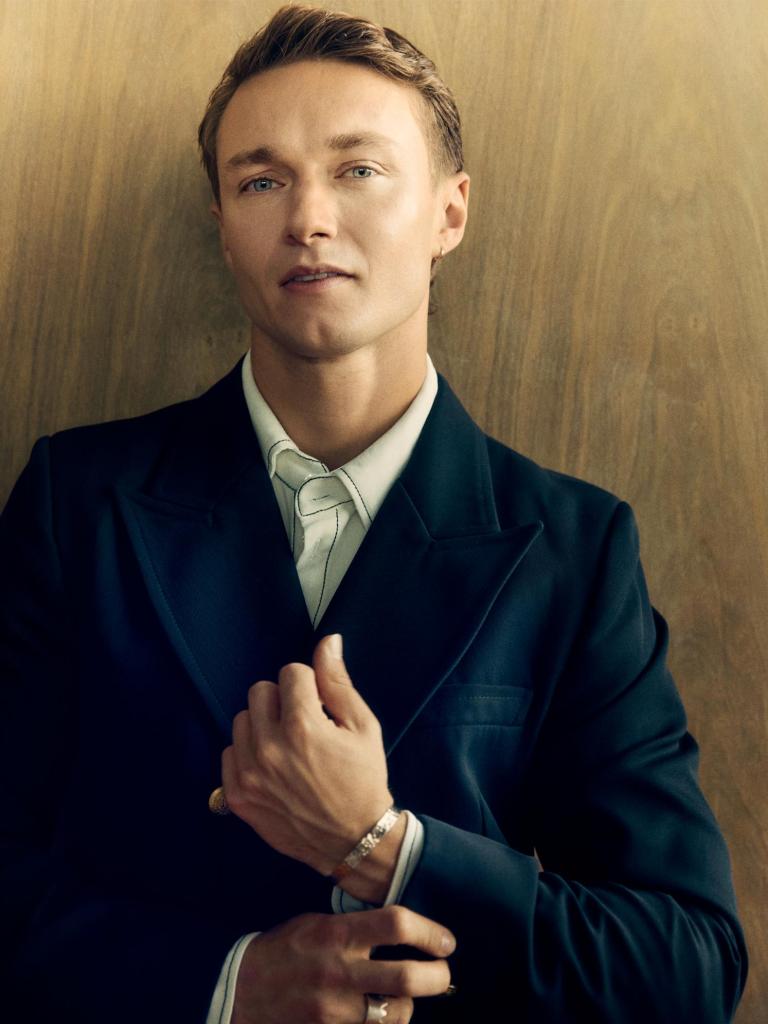
Suit and shirt Daniel Fletcher / Shoes GH Bass
I’m the same way. I think that’s why I’m drawn to things where people are so expressive and are so authentically themselves. RuPaul has this quote that I’m going to butcher, but it’s basically about how you can’t be afraid to look stupid and embarrass yourself. You just have to do it.
I love that. It’s definitely a skill—learning how to let go.
Speaking of you being more structured, you said in a previous interview that you tend to be stressed about the future as an overthinker, and how that can hinder you from savoring moments as you’re in them. Is there something you’ve done, either through rehearsals or in these early performances, that has helped you stay grounded and soak in the moment?
That’s why I wanted to do this show. I was really overthinking about whether I wanted to do it or not and get back into theatre, but I’m so glad I’ve taken the opportunity because I’m enjoying every moment of being on stage. I do still have a tendency to think about it before I come out for my first scene, but the reactions have all been positive so far. I’ve had some friends come and see it, and they’ve all seen a new side of me where I’m being playful, and not being so in my head about things. It’s been a special, revealing experience that I’m very happy to have taken.
Hopefully you can then carry that into other things as well now.
I’m also trying to, as I mature, relish these moments because they don’t always come around. Instead of just worrying the whole time, I’m trying to be present and immerse myself in it and reap the rewards from it while I can.
It can be a hard lesson to learn. Like you were saying a moment ago, I always try to remind myself that letting go is a skill, and it’s a daily practice, and I have to be willing to start over every single day and say, “I’m going to just be present and not be stressed.”
Totally. We can always start our days like that and see where we end up.
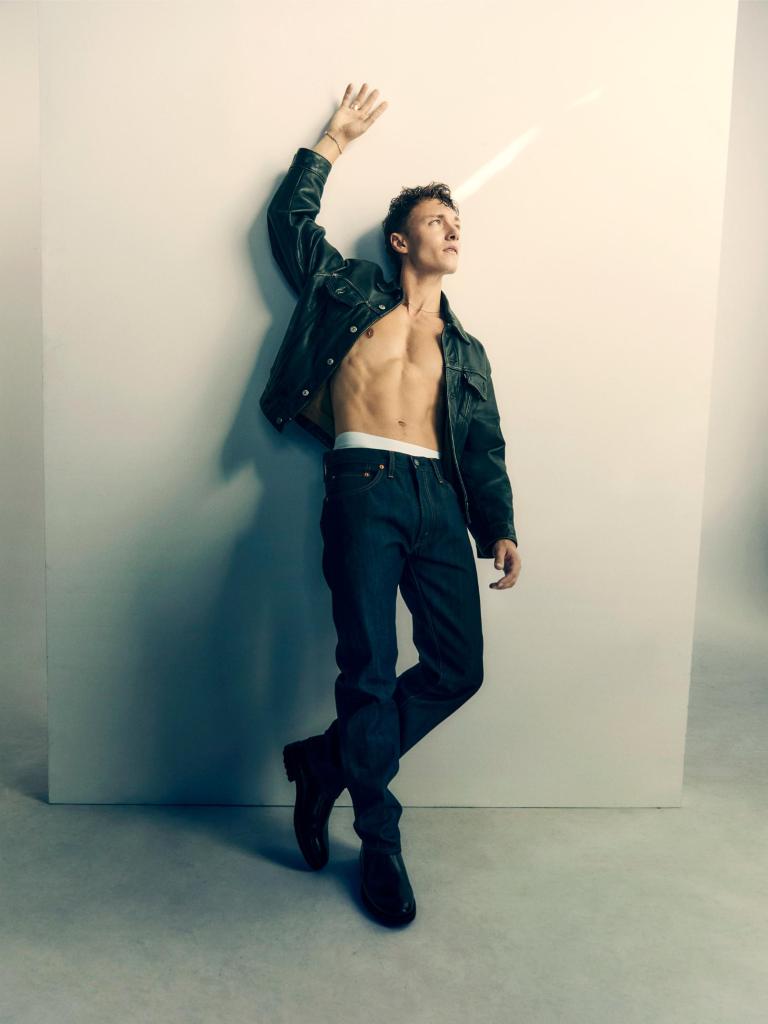
Jacket and jeans Levi’s / Pants Calvin Klein / Boots Vagabond
There’s so many different things we have to factor in, but us overthinkers are doing our best!
We are doing our best!
One of the underlying heartbeats of Invasive Species is the concept of found family, and being able to identify and connect with people who genuinely see you, love you, and want to help you become the best version of yourself. What qualities do you find yourself gravitating toward when you’re seeking out members of your own found family?
Warmth and openness are important to me. We live in a world where there’s access to everything through social media, and it feels very open, but we’re also very closed off at the same time. We have this ability to message so many people around the world, but then when you’re in front of someone, we sometimes shut away our inner selves. At least I do, anyway. When I meet people who are warm and open, and who aren’t afraid to let loose a little bit and to be playful and funny, that’s important to me. It puts both people on a level playing field, and there’s no archetype of status or position in life or anything like that. And that’s similar to my family environment as well. I’m very close with my family, and there’s a group of maybe 14 of us cousins, aunts, uncles, and I’ve always enjoyed that collective group. I feel that way about the friends I have as well.
That sounds really nice that you’re able to have both things co-exist where you feel close with your actual family as well as with the family you’ve been able to create for yourself. That can be a rare thing sometimes.
I’ve been lucky that I’m still friends with my school friends of 20 years, and with people from my drama school as well. I’ve always tried to keep friend connections going. It can be a nice reminder when you’re looking back at what you were like 10 years ago, or 15 years ago, and seeing that growth, or what you’re still thinking about in the same way. It’s great to have that foundation of people, and hopefully you can grow from it, too.
Yeah, absolutely. In terms of maintaining those connections, is there one thing you feel like helps you do that well? It can be hard to stay in touch with people over the years and maintain the same connection, especially when, as you’re saying, you remove the commonality you once had if you’re not at school together anymore or something like that.
I don’t know what it is, honestly. Maybe alcohol. [Both laugh]. That seems to be a good common ground for most people. No, I think it’s just experiences. Even if it’s going for a walk around the common, or going for lunch at a pub, just doing something that’s wholesome. And by doing an activity together, a memory is always created from that. I always try to do something active to generate that continued connection.
It’s different with every person and every interpersonal relationship. You have to dial it up or dial it down to figure out what works.
Some people are like, “You want to go for a 90-minute walk together?!” [Laughs]. And then I have to tailor it to something they’d rather do instead, so you’re right, it is different with every person.
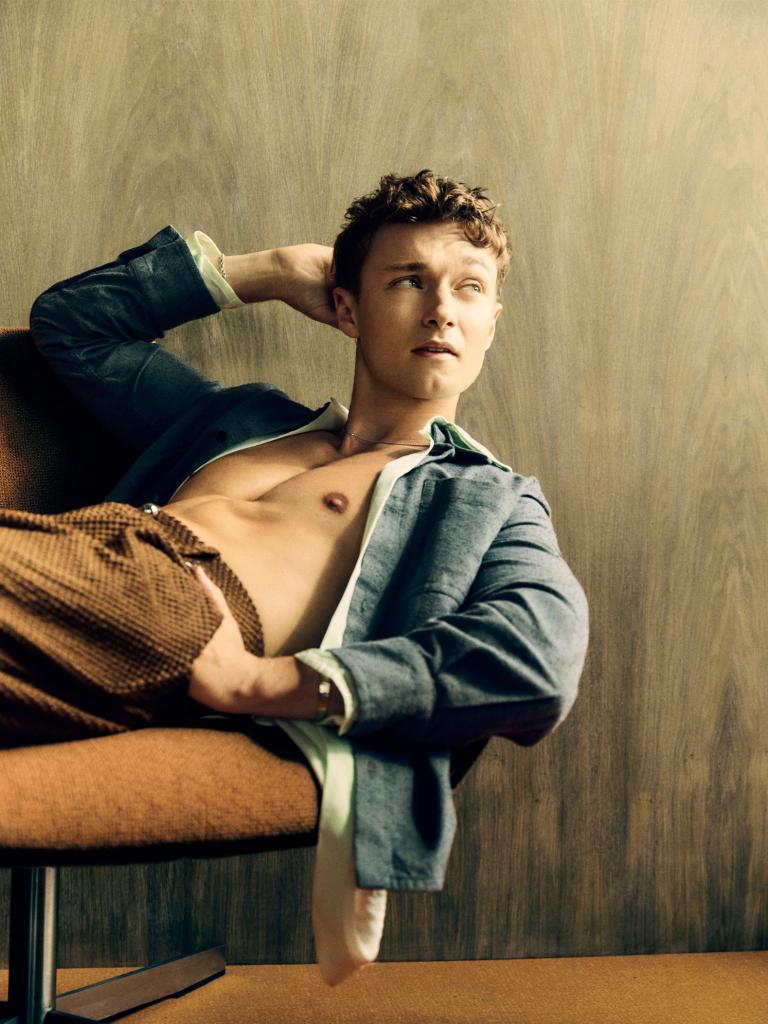

Shirt Bottega Veneta via Designer Exchange / Trousers Wealthy Boys Club / Shoes Grenson / Jewellery Harrison’s own
The play also explores the deep ache of not belonging, and the drastic measures we all take to fit in, even if it means shedding traits that make us who we are to achieve that goal. In your own life, how do you navigate the tension between conforming to society’s expectations of you and staying true to yourself?
It’s really hard for me to do, but music helps with that. I have different playlists for how I’m feeling that represent those emotions for me. Music helps me navigate through everything, I think. And also fitness. That’s a big thing for me in terms of letting go of everything else is to be able to go to a gym or do a class and separate myself from everything that’s going on in the world. Those two things help me switch off the most.
You mentioned music earlier as well when you were talking about locking into your characters to get ready for the play. Is there a certain song you have on constant rotation right now?
It was played here earlier, actually, but for one of the characters, where I’m the personification of an acting bug, I’ve been playing “Pink Pony Club” by Chappell Roan. That usually gets me into the mood of being an energetic bug for some reason. [Both laugh]. But it can be a real mixture.
Do you have a general go-to playlist you listen to every day, or do you always build them based on your moods?
I have 80 playlists for different moods, and they’re all terribly named, and I hope no one ever finds ’em. Sometimes it’s different every couple of hours, though, so it can be a real wild ride of different music from my childhood to music that I listen to now.
That must be interesting as an actor, because you’re creating these sustained connections between certain songs and certain performances. Do you feel like that’s a good way of revisiting the past—by listening to old playlists and remembering how you felt when you were working on The Irregulars, or another project you’ve done?
Yeah, I was just thinking about that, actually. I used to listen to a playlist when I was walking around Liverpool for that, and it was very rock-y at the time. It does bring back certain memories and emotions, and that’s why I find music really useful for character work. And even for photoshoots. One of the outfits today had a cowboy hat with it, and I was like, “Let’s put on some Post Malone and go down that route.”
Do you feel like, when you’re doing these photoshoots, that you’re able to be your authentic self? Or do you feel like it’s another performance in a way?
When I first started doing these photoshoots, I found it really hard to show myself, or I sometimes didn’t know what my authentic self was. I find with the fashion, and sometimes with the photographer and the styling, it’s exciting to make new characters, and that helps me push it a bit further than just standing there looking the same in every shot. Since I’ve gotten a bit older, I feel like my personality is shining through more, and I can feel more comfortable, and a bit cheekier, and that’s exciting. I always find it helps to create characters with each look, though, and to push a bit further to make sure that personality comes through on camera.
That’s fascinating to me. I’m very camera-shy and don’t like having my picture taken, but it seems helpful to have a set process in your mind of how to approach it.
It’s not really me, though. It’s like this weird being that’s dressed in all these different clothes.
So, like a representation of you, but not necessarily you.
Exactly. That’s exactly how it feels.
Maybe that feeling will lessen over time. As we get ready to wrap up, I wanted to ask a few random questions. If you could adapt any book for the stage or screen, what book would you choose and which medium would you tell your adaptation through?
I’m trying to think of what I’ve been reading lately. I don’t know if they’ve done this, but they probably have, and there should definitely be a film adaptation of Ernest Shackleton’s “South” and his voyage to Antarctica. Has there been a film made of it?
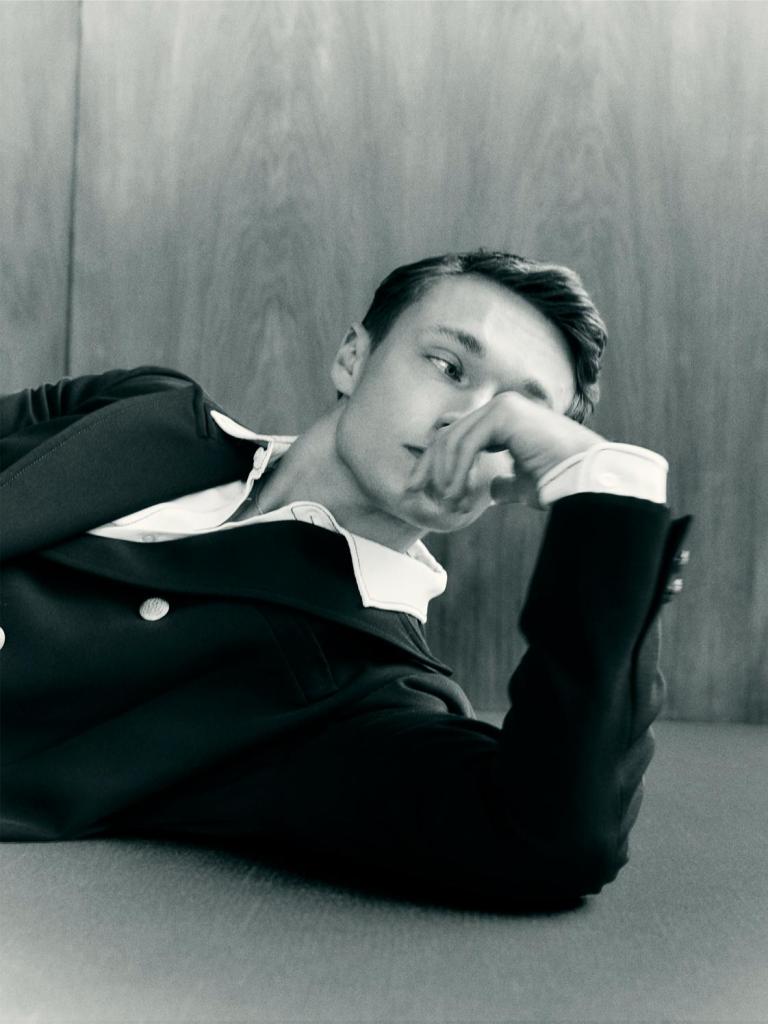

Suit and shirt Daniel Fletcher / Shoes GH Bass
I’m not sure. I know there were a few documentaries, but we should check if there’s a dramatised film because I would watch that.
It’s time to revisit it if there isn’t. I went to Antarctica a year ago for two weeks, and it was incredible. And then I read “South,” and that adventure story is potentially one of the best in the world. I would make it into a series actually, because there’s too much to put into one film. It’s between that and I’m also reading a beekeeping book at the moment, but I don’t think that’s going to work for an adaptation. Maybe the dos and don’ts of beekeeping as a podcast. Maybe that could work?
I would listen to a beekeeping podcast, for sure. What drew you to beekeeping?
I am a certified beekeeper. I did a course last year for it. That’s one of my red flags in dating, I would say. [Laughs]. But yeah, watch out, beekeepers, here comes the podcast!
That’s incredible. You can make your own honey, and bees are so important for the environment, so I applaud you for taking care of them.
Yeah, you’re welcome. No worries. [Both laugh].
Your trip to Antarctica sounds amazing, by the way. I love the cold, so anything I could do to explore that sounds ideal.
It’s pretty cold there, so you would definitely like it. It was the coolest trip I’ve ever done. The wildlife was incredible, and I went with a company called Abercrombie & Kent, they do these amazing experiences. I felt very lucky to go
This is a good segue because in addition to your acting career, you pursue a variety of other exciting projects, like modeling and your rum company, HAMA Rum. What’s the most gratifying thing about being able to pursue different interests simultaneously?
I think it’s about keeping busy. I find it hard to sit around and do nothing, and in the acting world, as much as I’d love to be doing it consistently, it’s very difficult to do that. Doing these other ventures where I get satisfaction from working hard through different mediums, but all under the same bracket of being creative, is really special. I feel lucky that I get to be able to try new hobbies and to also turn them into business ventures. Not that I’m going to be turning the honey into some multimillion-pound thing, but having these outlets is an important way for me to keep my mind active and to tell stories at the same time. They’re all storytelling in different mediums.
I think that idea of framing your pursuits through the lens of being creatively inspired, and how you can tell different stories through these projects, is really beautiful. “Harrison’s Honey” would be a great business venture. I don’t drink alcohol so I don’t know if this would be any good, but you could also combine your rum business with that and make honey rum.
I definitely could do that. I’ll be Jeff Bezos before you know it.
Listen, somebody has to bring him down.
Someone’s got to go for it. And I think it’s going to be me and my honey venture.

Shirt and trousers Wealthy Boys Club / Shoes GH Bass
It’ll be you and your honey venture, because you’re incapable of relaxing. To bring it back to Invasive Species, the show is deeply personal, and it displays a sense of humanity that serves as a mirror between this work of art that Maia has created and the audience. What is the one lesson you hope people take away from this production?
The play does a great job of opening up conversations about mental health, ambition, and obsession, and I think it’s a dark, satirical look at it, but also the message is to have these conversations and not go at it on your own. The fact that this is even an ensemble piece and that it’s Maia’s story, but it’s not a one-woman show, speaks to that. You need to have these conversations, and they bring new attributes to your story, but also it’s a safe place where you can share it with other people. It’s important to build a community and to open people up to the conversations that sometimes we don’t want to have.
‘Invasive Species’ is playing at the King’s Head Theatre until 3 October. Tickets are available here.