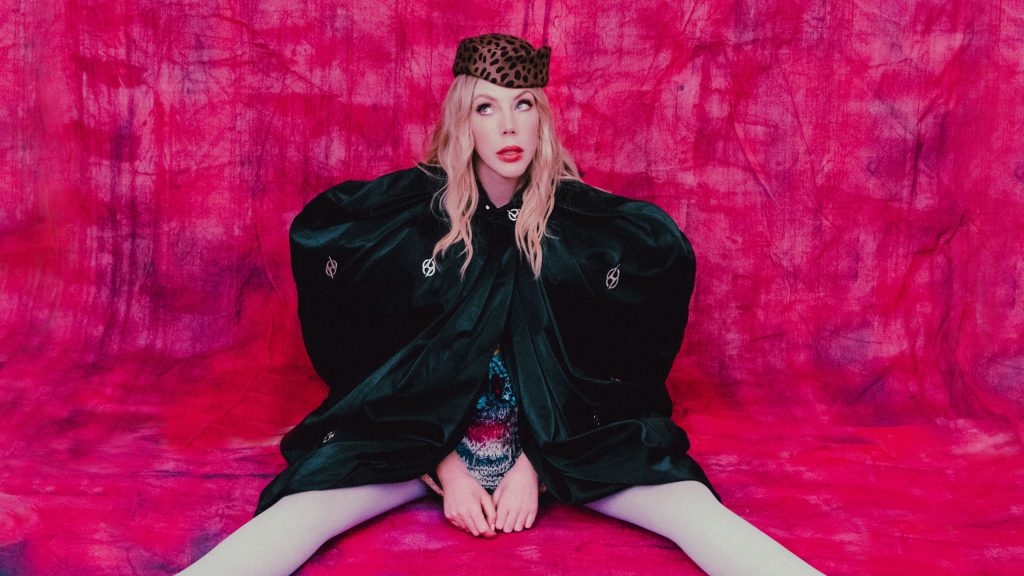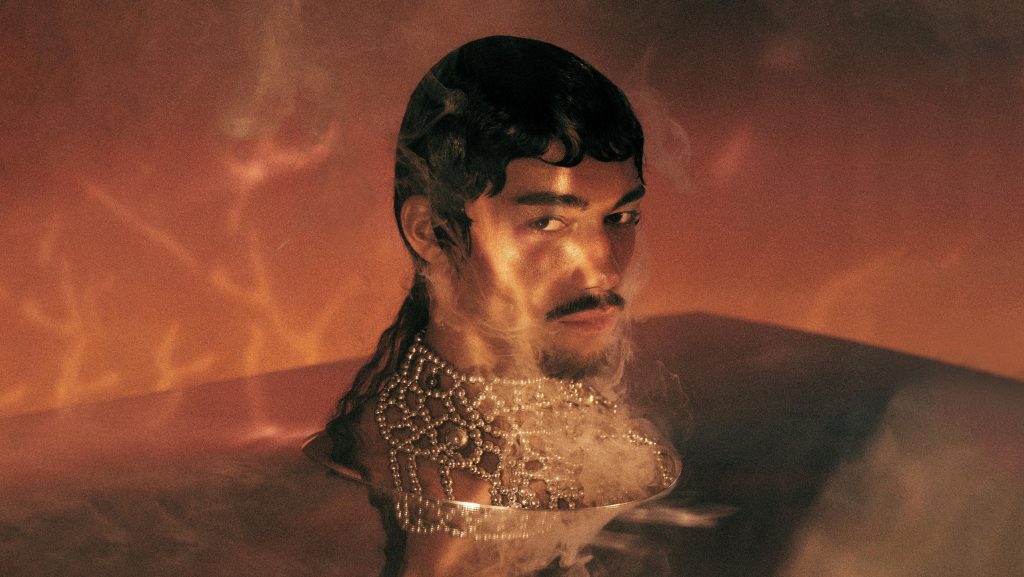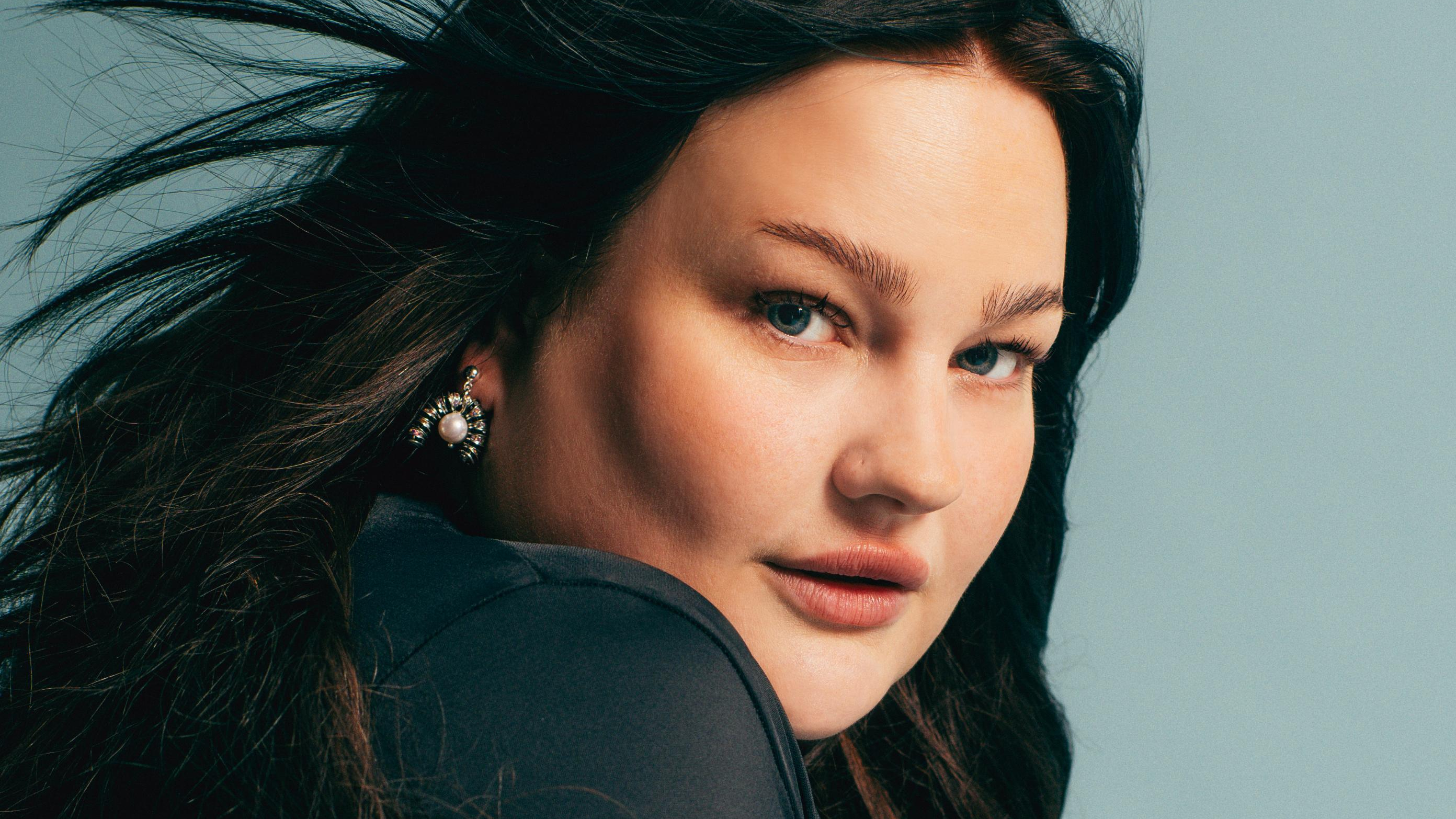
“Would you mind if I do my makeup while we chat?” a fresh-faced Sarah Klang politely asks as Principle joins her for an early morning Zoom call. Sitting in her room in Gothenburg, Sweden, she looks perfectly fine as she is, but we’re happy to let her get ready for her busy day. We’re here to discuss her soon-to-be-released fifth album, Beautiful Woman, which delves into what it means to be a woman today. The album touches on themes like needing love while fearing the co-dependency it brings, as well as struggles with body confidence.
PHOTOGRAPHY
Jack Alexander
FASHION
Harriet Nicolson
@ Stella Creative Artists
Beautiful Woman follows Mercedes, an album named after and inspired by her daughter. While many expected her new album to focus on how motherhood has changed her, Sarah explains that becoming a mother made her reflect more on her younger years. “When I got pregnant, it made me reflect more on my own upbringing than on womanhood itself,” she shares. “It’s more about reflecting on what you’ve been through and who you want to be when your child arrives. That’s what led me to write about my childhood and teenage years.”
With four critically acclaimed, country-tinged albums under her belt and a steadily growing fanbase, Sarah is the first to admit she’s not a household name. “My music has made me somewhat famous here in Sweden, but I don’t really get talked about in the press,” she says. “That’s partly because I rarely do TV and partly because I’m trying to keep it low-key on Instagram. I’m just trying to stay under the radar.”
However, that may be about to change. With this release, Sarah is embracing a more global audience, including a spring tour that stops off in London on April 29. She says this new chapter has rejuvenated her, rekindling her love for writing and performing.
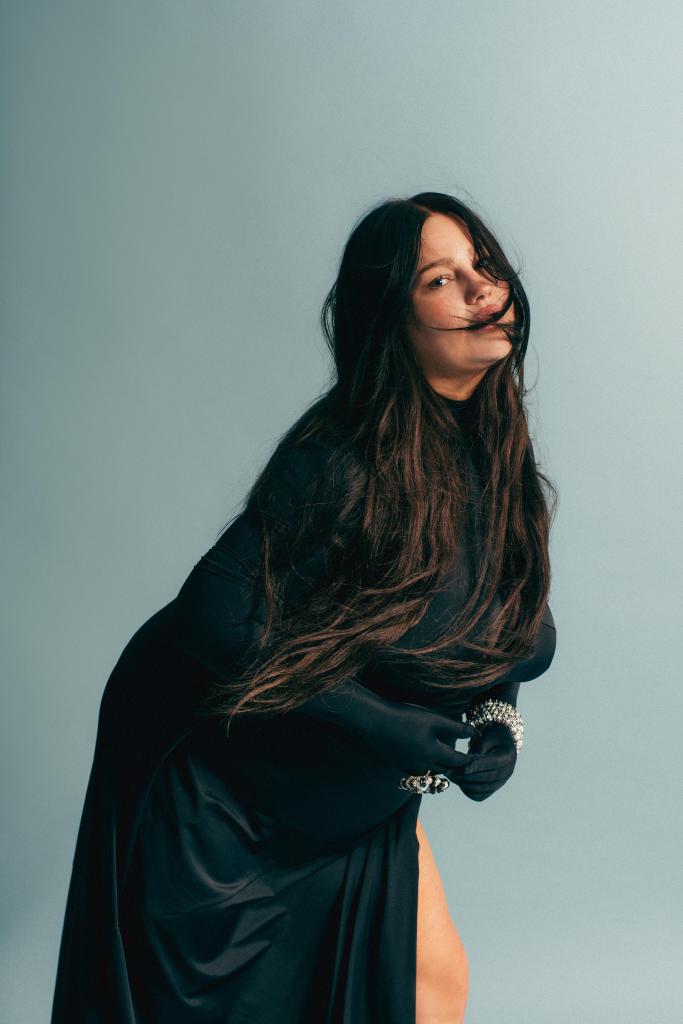

Dress CRITTER / Shoes Azalea Wang / Earrings, bracelet and ring PEARL OCTOPUSS.Y
Sarah, you’re been producing music for years now, but do you still get excited when you release a new album?
Oh, I do, definitely. But with this album, the excitement feels a bit different because it’s my first release that’s really getting attention abroad. That’s brought a fresh spark to the process for me. If it wasn’t for that, I might feel like, “Why am I even doing this? Do people care?” But now, I’m booking shows in the UK and the US for the first time, and that’s a huge motivator. It reminds me why I do this—it’s for the music.
Was this new exposure to international audiences always a dream of yours?
It’s always been the goal, for sure. When I released my album Virgo, it felt like things were starting to move in that direction, but then COVID hit. Suddenly, all the momentum we had built stalled. I couldn’t tour or do press properly, and it felt like a huge setback. We were even supposed to go to South by Southwest with the full band, but that never happened. I did manage a European tour when restrictions eased, but it wasn’t the same. Since then, it’s been a slow climb. My manager and I worked so hard—she even started a label just to release my albums. Now that I’ve signed with Network for this new album, it feels like we’re finally back on track. I’ve never wanted to be known as just a Swedish artist. I’ve always wanted to connect with a wider audience.
That must feel rewarding after so much hard work. When it was just you and your manager, did things change once a label got involved?
I think I have as much free rein as I want. They’ll, of course, come with their ideas. For me, it seemed very far-fetched to even start a TikTok when I met them. But they’re just trying to keep up with the industry. And I feel like record labels today—well, they call it the Wild Wild West right now because everyone’s like, “What the fuck is going on? How do we do this?” They knew how their field worked for years, and then all of a sudden, it shifted with streaming. So I don’t take it as criticism. Sure, it can be annoying when someone’s like, “Can you mime your own song walking down the street?” But that’s their job, and I respect that. I won’t die from anyone trying to help me. But I think it’s extra important now for artists to reflect inward and decide what they’re willing to do. I always ask myself, “Is this something I can live with?”
So have you had to embrace Tik Tok?
For example, I started a TikTok with my best friend Frederica, who does all my artwork. And we said, “Let’s just do it. It won’t kill me, and we can try to make it fun.” I don’t really care about it, though.
We’re guessing being a songwriter, a singer, an artist is your priority. The external stuff—publicity—is something you’re kind of forced to do. Pop stars post five-second clips, and people are left thinking, “What’s that about? Why is that there?” Sometimes it’s nonsense.
I mainly do beauty content. I’m doing something I can live with. But I get suggestions like, “Can you sit in your bedroom and talk about your childhood?” Or when you’re branding an album, the suggestions can be so cringe. When I released Mercedes, I was just like, “Oh my God, the ideas coming my way are so cringe right now.” But their job is to try everything. I’m just a random artist in Sweden, and they’re taking their time trying to get noticed in the ocean of content.
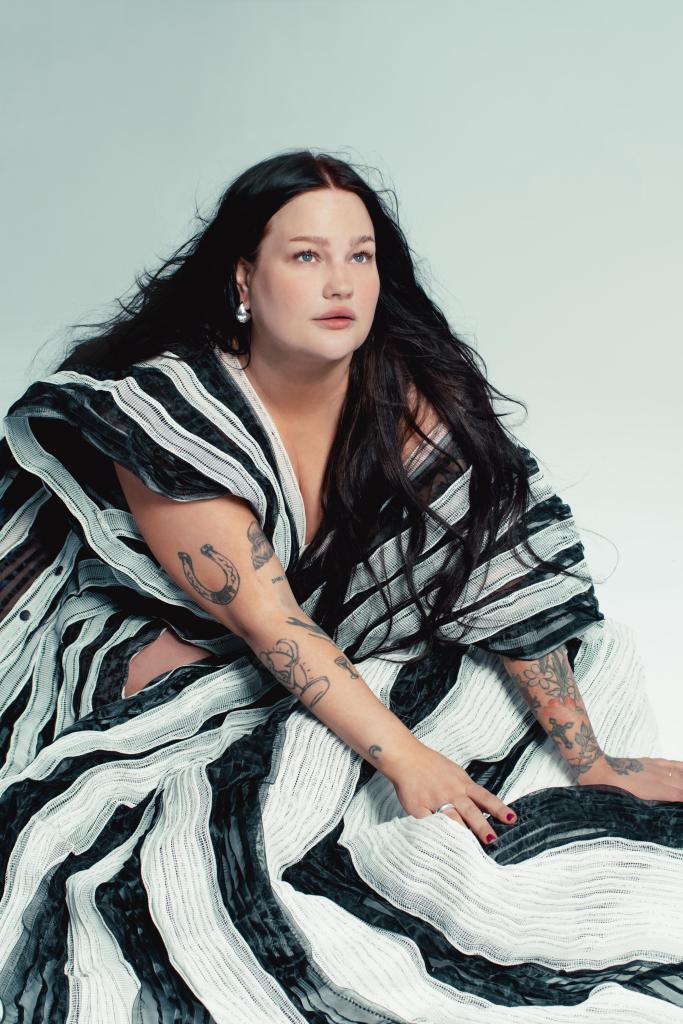

Dress Maximilian Raynor
Absolutely.
My fiancé, who’s 43, said something that stuck with me. He said TikTok is strange because it’s like short music videos, but bad—bad quality, no budget, bad phone camera angles. But I don’t know. It is strange.
TikTok has had such an influence on music itself that songs are two or two-and-a-half minutes long, each with a hook designed for a 10-second clip.
I think that’s why it doesn’t really hit me. I know it will never really fit with my music. For me, it’s more like Instagram—I enjoy Instagram. But when TikTok came along, I think I was a little too old to get excited about it. When Instagram launched, I was extremely excited and shared so much on that platform—crazy personal stuff, especially on my earlier account. I think that was part of why people found my music in the first place because I was very funny and open. Now I find it boring, but that’s because I’m more cautious.
Is that because you’ve stopped sharing personal things over time?
Absolutely. I used to post crazy pictures of myself crying, almost naked, drunk—my bandmates, too—naked and drunk. It was all just, like, “Bleh.” But now, no. I’m a mom.
Did that change happen because you became a mother, or was it before?
The change came a little bit before I got pregnant. I realized I could kind of go under the radar here in Sweden. My music has made me somewhat famous here, but I don’t really get talked about in the press. That’s partly because I rarely do TV and partly because I’m trying to keep it low-key on Instagram. I’m just trying to stay under the radar.
That’s a smart move. These days, musicians seem to do too much – releasing music, they’re also spokespeople on social media, doing perfume campaigns, or acting. It feels like the idea of being solely a singer-songwriter is getting diluted because so many people are doing everything.
I’m figuring that out too. I’m a girl who loves makeup and clothes, so when a brand asks, “Do you want these shoes?” I say yes. But then I feel obligated to tag them. Sometimes I look at an artist’s Instagram and wonder, “Is this an influencer account or an artist’s page?” I try my best not to do paid collaborations yet.
But if any offers come in…
If someone came with a huge amount of money and said, “Make a commercial and just sit there and be chill,” who am I to say no? I didn’t grow up rich—I’d take the money.
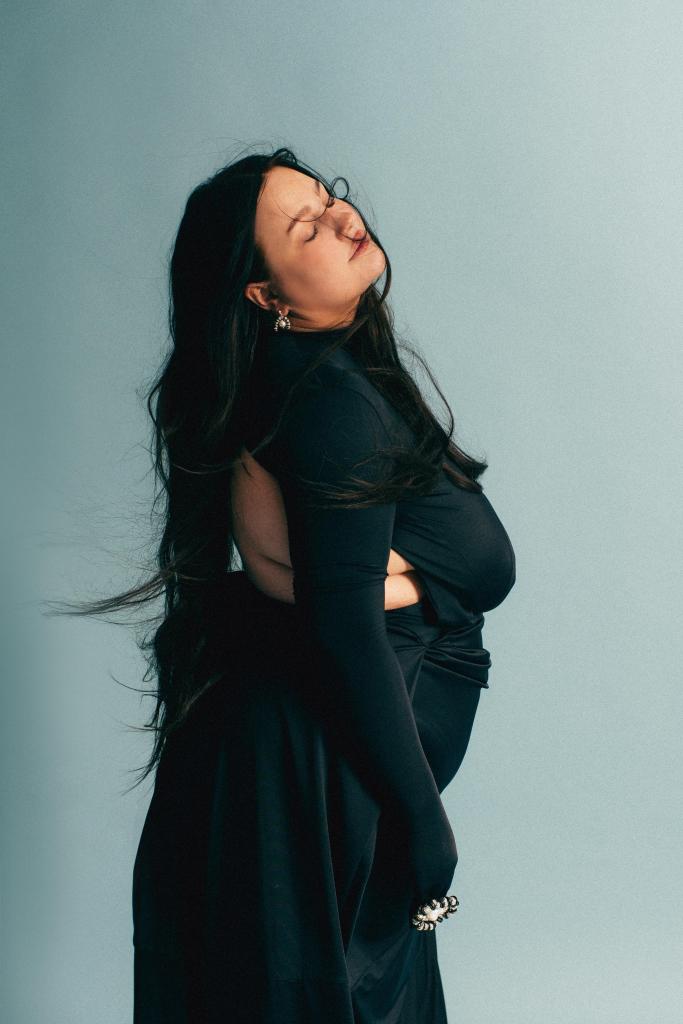

Dress CRITTER / Shoes Azalea Wang / Earrings, bracelet and ring PEARL OCTOPUSS.Y
You can’t turn down opportunities like that. Anyway, back to your album. You’ve said it’s about womanhood. Has becoming a mum changed what being a woman means to you?
Naturally, yes. I get asked how I think about my daughter’s upbringing and her womanhood. But honestly, I haven’t thought about it too much in that way. I think about her as a little creature, a child. When I got pregnant, it made me reflect more on my own upbringing than on womanhood itself. I think that’s normal—my boyfriend did the same. He started thinking a lot about his dad. It’s more about reflecting on what you’ve been through and who you want to be when your child arrives. That’s what led me to write about my childhood and teenage years.
When you reflected on your past, were there things you decided you wanted to do differently as a parent?
The main thing is wanting to provide a safe home. For me, I always think about being a chill, non-emotional parent. I love my parents, but they were very emotional. That’s something I don’t want to be, but knowing myself, I’ll probably end up the same way! My life and career—everything revolves around music and traveling. My goal is to hopefully be a boring parent she finds annoying. That would be ideal!
We don’t think you’ll be boring—you’ve got a great sense of humour. I think you’ll be a wild but fun parent.
Maybe not wild—just less focused on myself. I’d like my daughter to feel like the main character. That would be nice.
That’s a great perspective. Parents are there to give guidance and support, and one day they’ll come to you for help. I imagine you’ll be an open mom, someone she can talk to honestly.
Yes, that’s the goal. But you always want what you don’t have. My parents were very supportive of my music, even when most parents aren’t thrilled about their child pursuing a career in music. They always told me to go for it, that I was great. My dad even went to my friends’ concerts when we were younger, and they’d cry because their parents weren’t there. He supported our whole group of young artists, and that was amazing. But then, of course, I wanted the opposite—boring, Christian, married parents in a house. You always want what you don’t have. I think it’s part of life to go through periods where you need to be allowed to acknowledge the trauma. At least in our generation, I think we’re slowly coming to terms with things. I feel like I’m slowly reaching a point where I can tell myself, “You’re okay. You’re fine. Your parents are just people.” But for a while, I felt like, “I’m so messed up.”
What led to that feeling? What was the trauma for you, specifically?
For me, it was a feeling of rootlessness. We moved around a lot, and it felt like nothing was stable or safe.

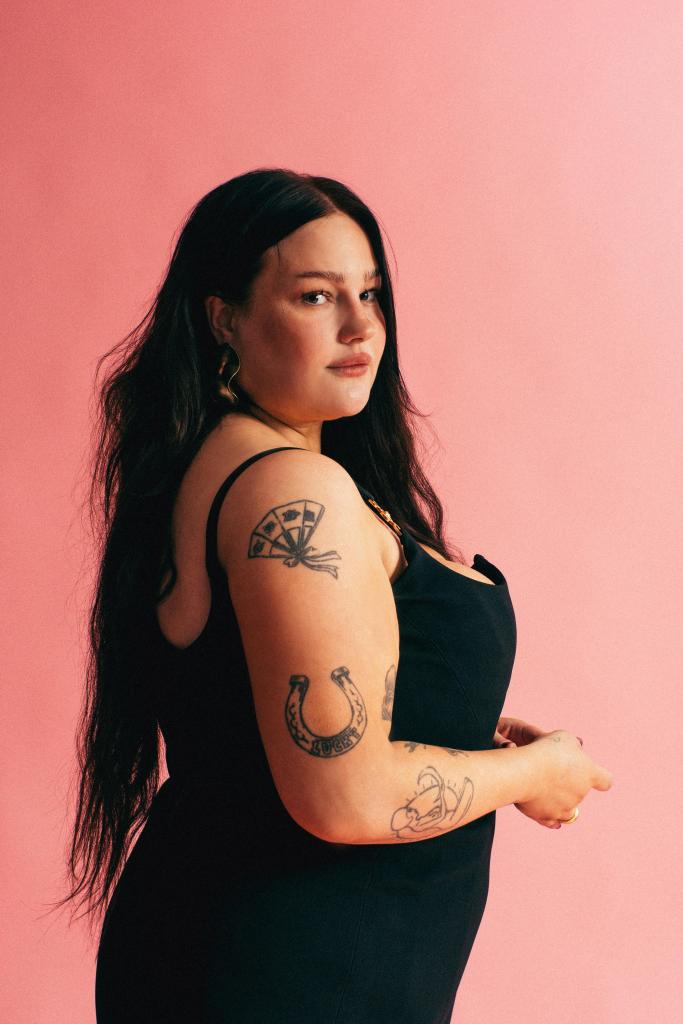
Dress Versace / Tights My Accessories London / Shoes Azalea Wang
Did your family move around a lot?
Yeah, we moved a lot. Not just locally, but far away—like from Gothenburg to the north of Sweden.
Were they on the run?
No, they weren’t together. My parents were separated, but there was always something going on. That uncertainty made me question my sense of self. It’s strange because in music, I’m so confident and people perceive me as grounded. But when I’m alone, I’ve struggled a lot with identity.
Have you sought help for that?
Yeah, I’ve gone to therapy and even went through a diagnostic process to see if I had something like ADHD or borderline personality disorder. But in the end, I was told I’m probably just a neurotic woman.
Everyone’s dealing with some degree of these challenges.
True. For me, it’s been a struggle with identity and staying connected to reality. I’ve experienced dissociation, where I’d need to touch a chair or something to ground myself. But I’ve learned it’s not uncommon, and working on the basics—like meditation, eating well, and taking walks—really helps.
I think a lot of people feel this.
That makes sense. I’ve felt the same, especially early in my career. On tour with my first album, everything was a blur. Now, I want to appreciate what I have—like being able to live off my music—and really enjoy it.
That’s why keeping photos or even using Instagram for memories is so helpful. It’s a way to remember and appreciate what you’ve done. Speaking of your album, some of the songs—like Beautiful Woman—touch on body image. What issues did you face, and have you overcome them?
I wrote Beautiful Woman as simply as possible. English isn’t my first language, so I just tried to describe things plainly. That song, and The Other Girls, could be about me or any of my friends. Growing up, I always thought I was bigger, never skinny enough. But when I saw pictures of myself as a child, I realised I was really skinny. It’s wild how much body image affects us. If it wasn’t my weight, it would’ve been something else—my face, maybe. But now, looking back, I see how universal these struggles are.
It’s something most people go through. We tend to waste so much energy worrying about it.
It’s true. But it takes age and perspective to reflect on those things.
Aging is such a double-edged sword. It’s great for self-awareness but tough in other ways.
Absolutely. I recommend aging—it’s worth it. It’s really good, especially for writing. Sometimes I worry, “What will I write about if I can’t write love songs anymore?” But then I remind myself that every few years, life brings new cycles, and I’ll find new ideas.
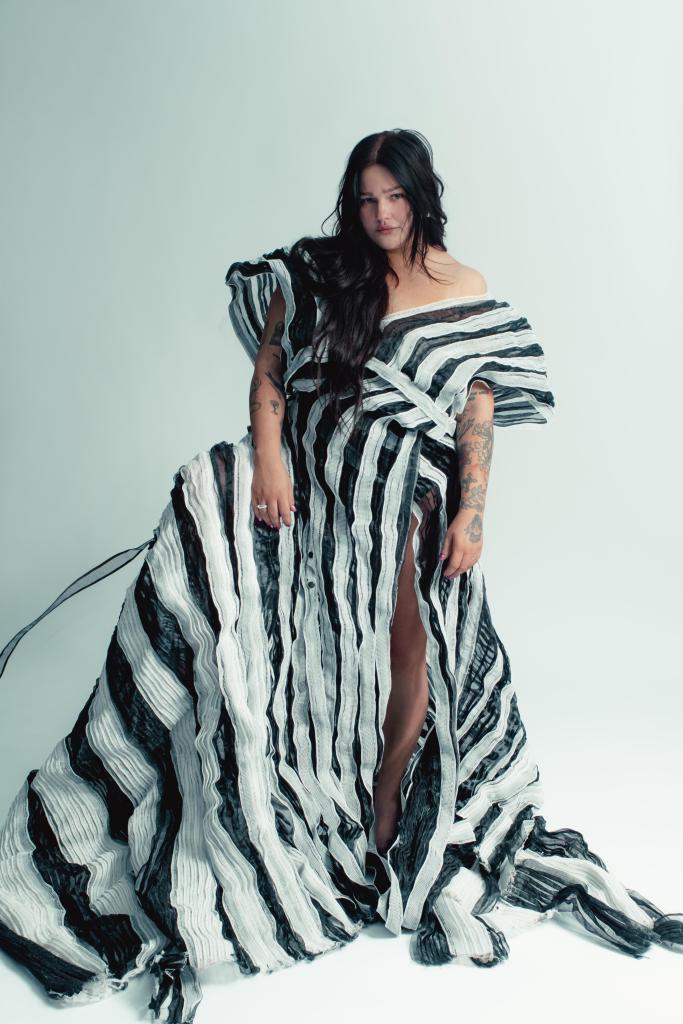
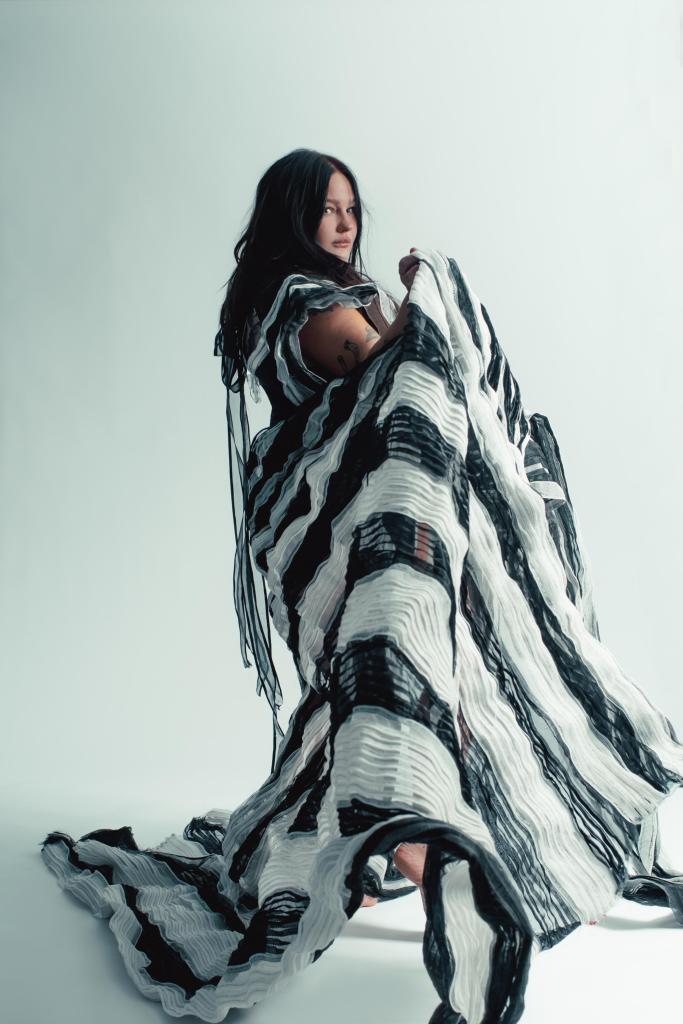
Dress Maximilian Raynor
There’s always inspiration somewhere. You’ll always be able to draw something out.
Lately, I’ve been writing a lot about my childhood and teenage years, and I feel like I probably need to move on from that. My parents are like, “We get it, Sarah.” So, yeah, I think I need to explore something else.
Life always opens new doors. You mentioned earlier about the images of women you saw when you were younger. The world has changed a lot—magazine covers now showcase women with more varied body types and even pop stars don’t all fit the mould they used to. It feels like there’s been a shift, especially around body confidence. Do you notice that change?
Absolutely. I think it’s great that there’s more variety now. When I talk to my girlfriends, who are all attractive and cool, none of them ever say, “Oh, I saw this guy on a reality show, and he was so hot.” Instead, they’ll talk about some older man with a crooked hat, and they’ll find that charming. It’s proof that beauty is subjective, and everyone has their preferences. For me, my feelings about myself fluctuate. Some days I have a lot of anxiety about my appearance, and other days I feel great. Growing up in the early 2000s, you couldn’t curate your social media feed like you can now. There were just a few blogs and magazines, and that was it. Of course, that limited exposure affected us.
Women seem to be driving so much of the music industry, now. Artists like Chappell Roan stand out as unique and experimental—almost reminiscent of some artists from the 70s. It’s refreshing.
Yeah, and in the kind of music I make, no one has ever pressured me about my weight. But I imagine that might be different for young pop artists signed to big labels with managers who don’t really know them. In my world, people are just supportive and focus on the music.
It’s good to hear that kind of pressure doesn’t exist in your experience.
It’s rare for me to encounter negativity. And when it happens, I just think, “You’re crazy.”
Things have changed a lot since the 90s and early 2000s.
The industry has shifted, but it’s also about how you present yourself. Personally, I’ve leaned into using my body and sexuality in my aesthetics. For example, I’d love to do a Playboy cover someday—not because I feel pressured but because it’s my style and what I find fun.
Even as a mum now, would you still consider doing something like that?
Absolutely. Being a mum doesn’t change that for me. But I do stay a bit under the radar on social media. If my audience grows, I know that might change. Once you get more exposure—like being on TV—you attract a lot of different people, including some who might be critical.
That’s true. Artists like Chappell Roan have experienced that shift. She was under the radar for a long time, but one hit song changed everything, bringing her a bigger audience—and some challenges.
I understand what she’s saying about the challenges of fame. But I also think you can’t have it both ways. People connect deeply with music and performances, and as artists, we have to accept that connection—even if it brings some uncomfortable attention. Fans have always idolised musicians, and that’s not going to change.


Dress CRITTER / Shoes Azalea Wang / Earrings, bracelet and ring PEARL OCTOPUSS.Y
Social media, especially platforms like TikTok, has created this illusion of direct connection. Fans often think the artist is speaking just to them, which can blur boundaries.
It’s true. Social media creates a unique kind of intimacy. It’s something artists have to navigate carefully, but it’s also a powerful way to share your art with the world. I’ve seen some backlash against Chappell Roan lately, and I don’t mean to add to that. I’ve seen her doing hair tutorials, which young girls would love. But that’s what I mean—you have to choose. If you want to be a private person, you can be. There are ways to balance it.
You mentioned idols earlier. Who are your musical idols? Not necessarily the ones who inspired you, but the artists you’ve enjoyed listening to. You referenced Britney Spears’ Crossroads—do you love Britney?
I mentioned the movie because I used to watch it. I know all Britney’s songs—I grew up with them—and all the Christina Aguilera ones too. But these days, I listen to artists like War on Drugs, Kurt Vile, and Kevin Morby. I feel like I’m always repeating those names, but they’re my go-to. When it comes to pop culture, I love the icons. Bruce Springsteen, for example—I’d love to see one of his shows. Or Cher—anything that sparks a vibe.
Are you a big Madonna fan?
I remember listening to her Confessions on a Dance Floor album on repeat as a teenager, especially the one with the ABBA sample. But that was mostly because it was the only CD I had that summer! Of course, there are people I’d be nervous to meet, like Courtney Love or Beth Ditto from Gossip.
They’re great examples of artists who started off as alternative but became more mainstream. Sweden is known for its melodic, pop-forward music. Did that influence your sound at all?
I get asked this a lot! It’s interesting because it’s made me think more about it. I think the so-called “Swedish pop wonder” gives people here a certain confidence. We grow up hearing about all the Swedish music icons—ABBA, The Cardigans, Robyn—and it instils this belief that we can succeed too. When I go abroad, people almost expect me to be good because I’m Swedish. It’s a strange kind of reputation, but it works in our favour.