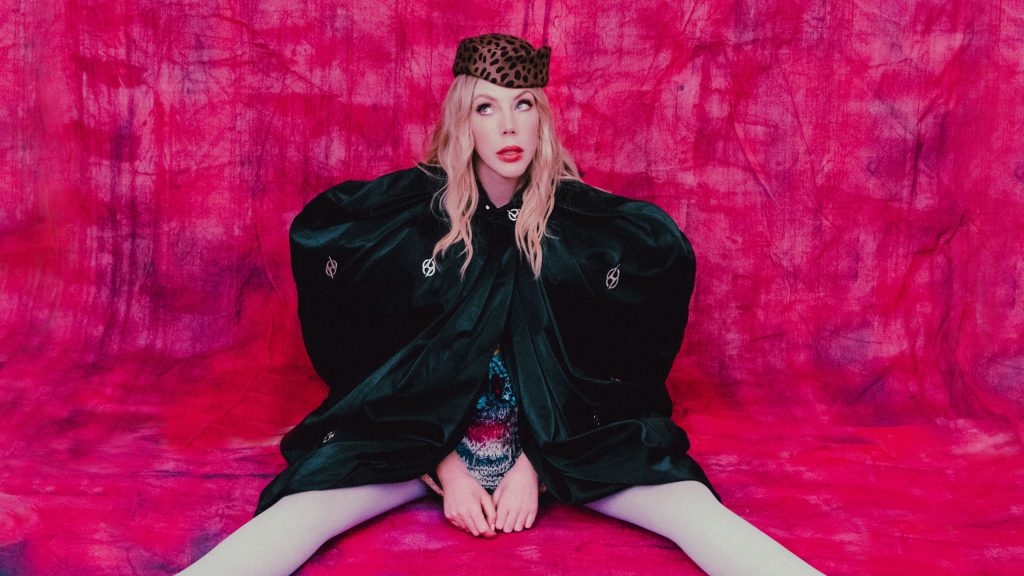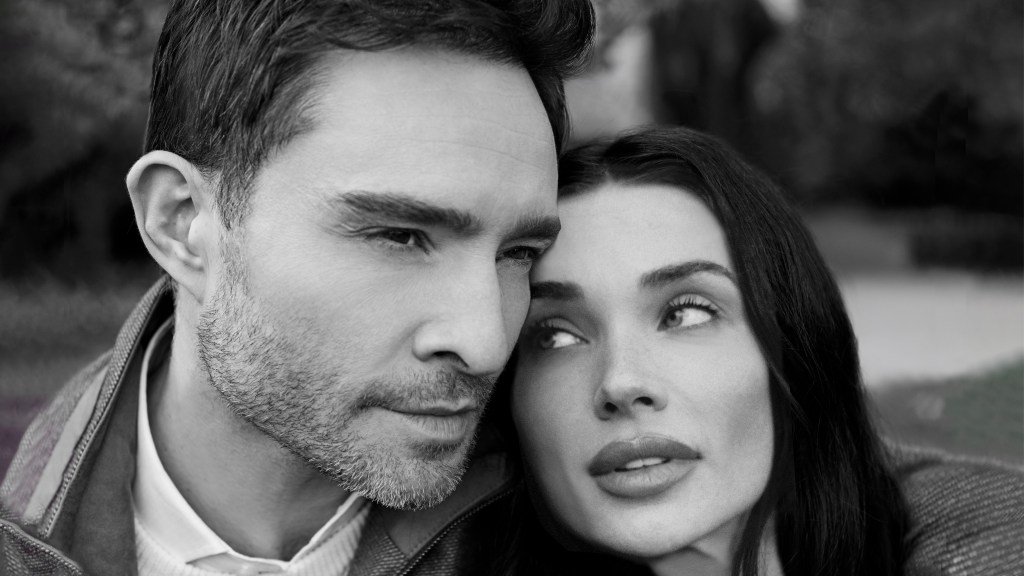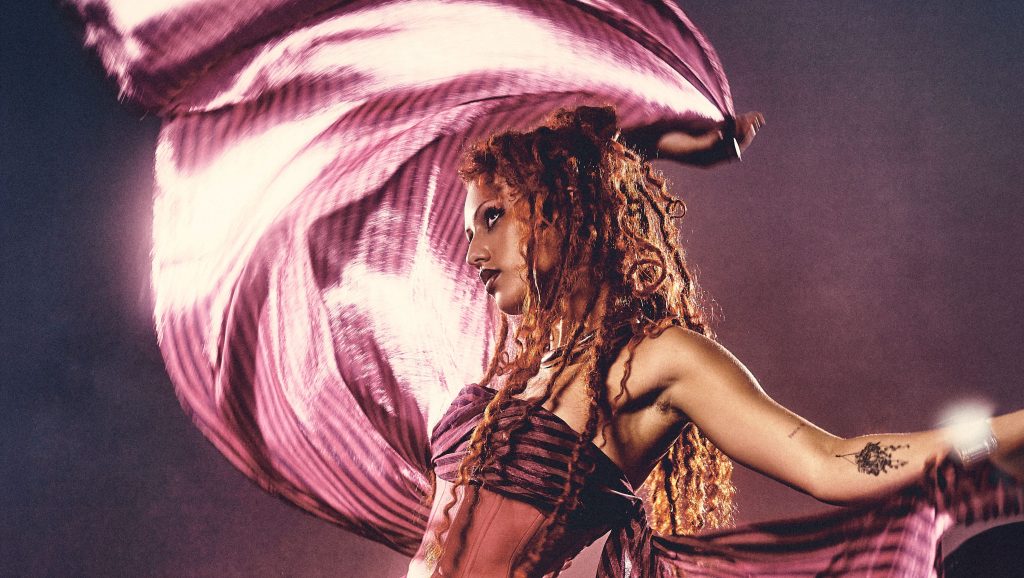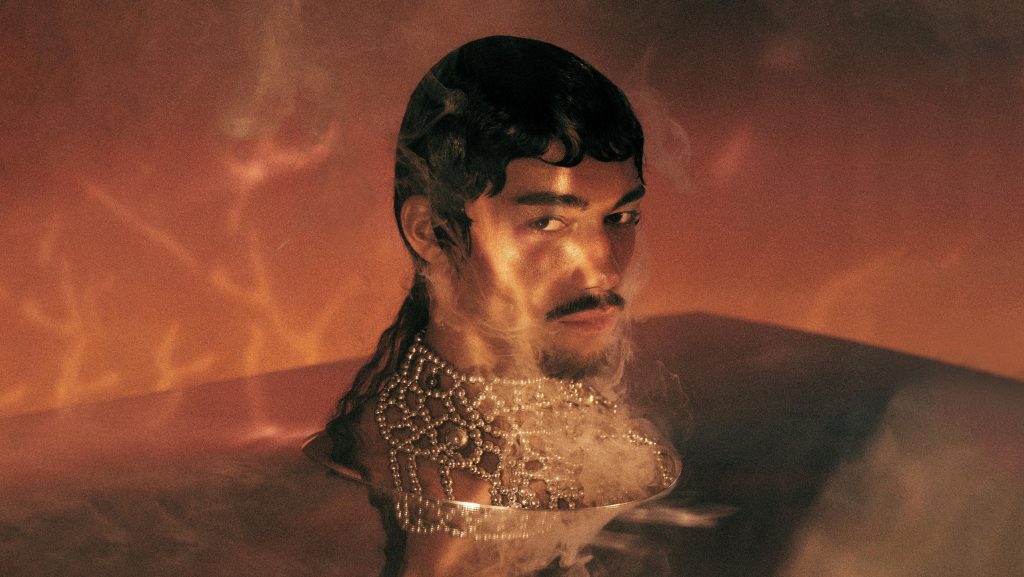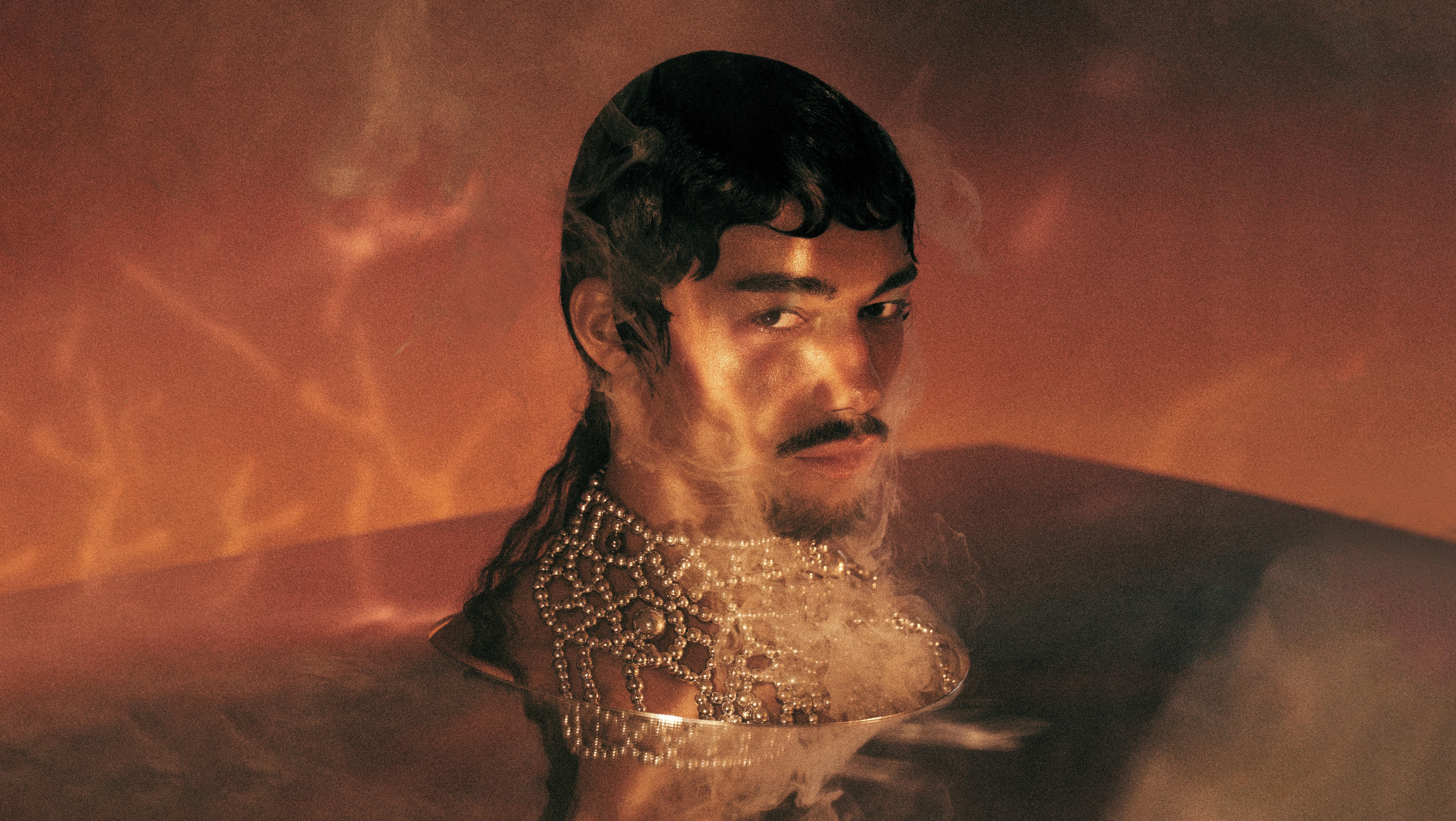
When model Reece King connects with actor and musician Keiynan Lonsdale, the conversation doesn’t stay on the surface for long. Both have spent years navigating industries that demand visibility while often leaving little space for softness, and here, speaking across London and Los Angeles, they meet in a moment shaped by change, distance, and reflection.
While each is known for a distinct creative path, both have built careers that move fluidly between fashion, film, music, and self-expression – spaces where identity is constantly being negotiated in public.
Essex-born Reece, known for his striking presence in front of the camera and his work within conversations around representation, has appeared in editorials for British GQ and fronted campaigns for brands including Diesel and Calvin Klein.
Meanwhile, Australian-born Keiynan has carved out a multidisciplinary career across television, film, and music, consistently resisting attempts to be boxed in. From his breakout roles in The Flash and Love, Simon to his music and public-facing work, he has built a practice defined by fluidity, vulnerability, and reinvention.
In an exclusive interview for Principle, the pair catch up to discuss everything from embracing fluidity and being a “chameleon” to success, creativity, and queer visibility.
PHOTOGRAPHY
David Yeo
FASHION
Kim Howells
HAIR
Nick Irwin
MAKE-UP
Kareem Jarche
using Natasha Denona
SET DESIGN
Lee Flude
at Agency41
PHOTOGRAPHER’S ASSISTANT
Alex Forsey
FASHION ASSISTANT
Lara Jones
HAIR ASSISTANT
Alex Sarghe
BTS VIDEO
Jack Alexander

Keiynan: Ciao, Reece. What the heck?
Reece: Hey, dude. What the hell?
Keiynan: I’m doing really good. I’m good. I’m calling you from LA at the moment, but I’m usually back home in Sydney. So where are you? Are you in London?
Reece: I’m in London, yeah. Well, just outside of London. I’m in Essex. I moved back to my hometown last year.
Keiynan: What spurred the move back home? That’s such a big thing to do. I can definitely relate — I was in Australia for the past four years.
Reece: I think it was a combination of a few things. London is just so expensive, and it keeps getting more expensive. I really enjoyed it when I first moved there. It was exciting having my own space, and it felt like a huge character-development moment. But after about five years, especially in that last year, I was like, ‘Wait a minute, I’m actually kind of miserable here.’
I was talking to all my friends about it, and a lot of them felt the same way. But so many people felt this pressure that moving back home would be somehow going backwards. I think I felt that too for a while, but then I realised it’s actually such a privilege to be able to go back to your family and have that support system around you. And Essex isn’t even that far from London, but that extra 20 minutes makes such a difference. I feel like I’m in the countryside. It’s more peaceful. It’s not as hectic or intense as London. So I think it came down to wanting more peace, the cost of living, and missing my family.
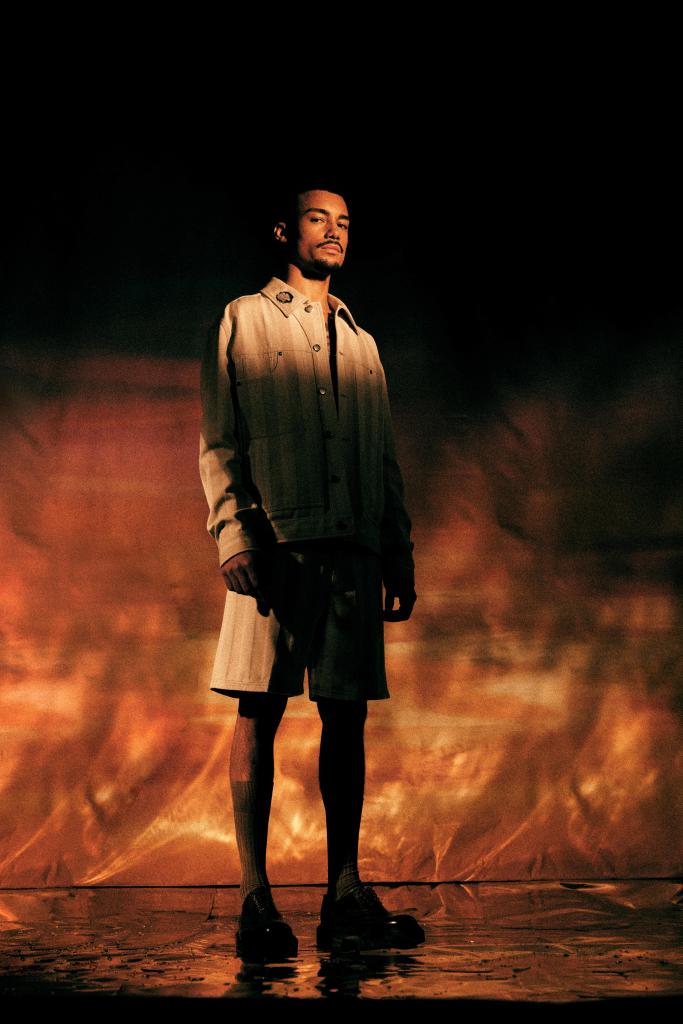
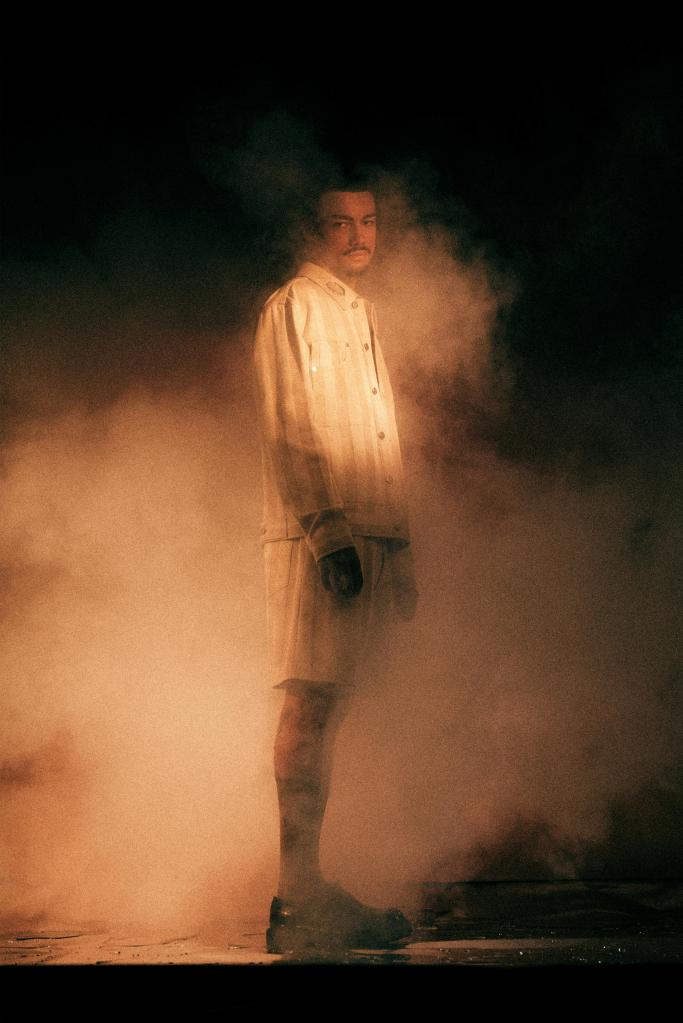
Jacket and shorts Fendi / Shoes Grenson / Socks London Sock Company / Brooch Xhen Xhen Jewellery
Keiynan: You can’t actually put a price on that. When you go that little bit further out, you’re surrounded by people who know you on a very particular level. There’s almost nothing surface-level about it. There’s a frequency you can tap into that I think we spend a lot of time — and often a lot of money — trying to nourish and fill when we’re living in these big, crazy cities. And I think for entertainers and artists who get so much stimulation all the time, sometimes home is probably the best thing we need.
Reece: I wish I’d done it sooner, but no regrets. Once I moved back, I was like, ‘Oh wait, I actually could have done this a lot sooner.’ But I enjoyed my time in London. It is what it is. I definitely enjoy being back in Essex. It’s a lot better for me mentally, and I feel like I’m doing better not being in the city all the time. And the thing is, it doesn’t even take that long to get back into London. It’s literally like 20 minutes.
Keiynan: I was going to ask you first — how are you? How’s your spirit? Where is Reece today? Not physically, but energetically. What space are you in at the moment?
Reece: I always answer that question the same way. Whenever anyone asks me, I always say, ‘I’m somewhere right in the middle. I’m really 50/50.’ I have good days and I have bad days, but I recognise that I have a lot more good days than bad days, so that’s a positive. But to be completely real, with the state of the world and just dealing with everyday life — the challenges, work, everything that comes with it — I feel like I really am just bang in the middle.
Keiynan: No, it’s good. Is that middle space somewhere you feel creative from? Somewhere you feel inspired by? As artists, we all know that being at one extreme or the other can create a lot of expression and inspiration. But what isn’t talked about as much is that middle ground. And for the long term, that’s probably important. You’ve been in this industry for a while now and you’ve been working consistently for a long time. So how does that middle space impact the way you look at work and creativity? What does it do for you creatively?
Reece: It kind of feels like the norm for me. I feel like I’ve been in that middle place for so long. I can easily swing from good to bad, but when I’m in that middle ground, there’s a sense of neutrality that allows me to shift quite easily. It doesn’t take me long to move into a more positive place or a more creative place. I guess it can just as easily go the other way, but I find it much easier to lean into feeling optimistic about things. I don’t want to say somber, but I can be very, like, what’s that word when you don’t really show emotions?
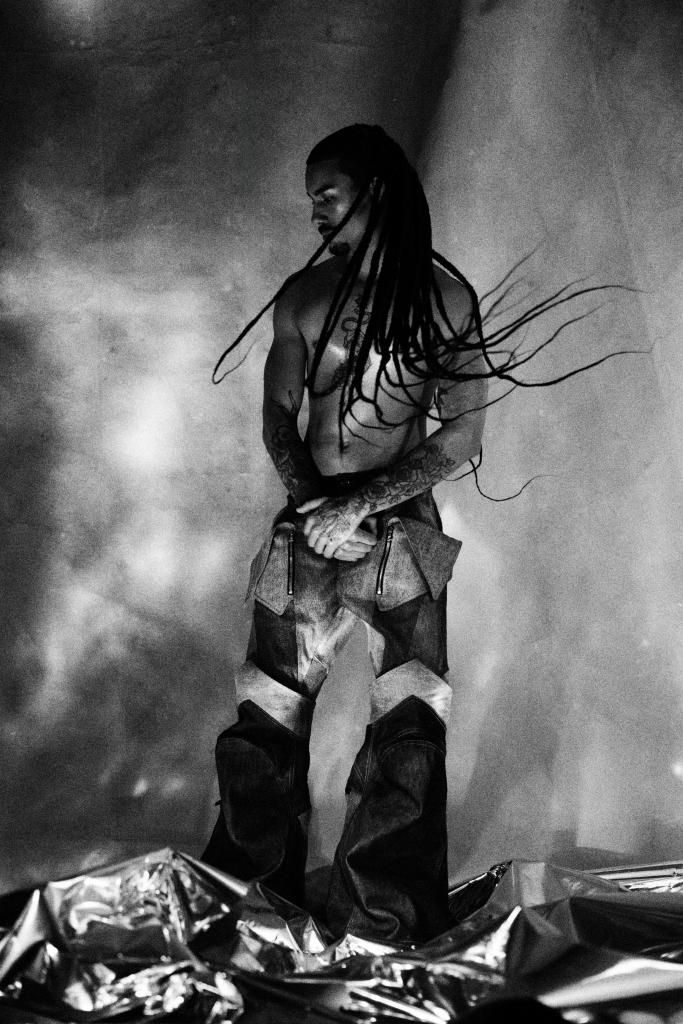

Trousers Yunli
Keiynan: Stoic?
Reece: Yeah, stoic. I feel like that’s me when I’m in a really neutral place. I’m not sad, I’m not happy — I’m just here and alive. Then something clicks and I’m like, ‘Oh, I feel really good.’ Usually, with work, it’s the people I’m around or whatever we’re doing that gives me that sense of excitement. But honestly, I’ve navigated life from that middle, neutral place for so long that I’m just like, yeah, it’s normal.
Keiynan: I love that place. I love that space. It’s one of the most satisfying places to be, and I think there’s a real quiet power to it. It doesn’t need to be explained, and I feel like you can make a lot of great decisions from that space.
Reece: Exactly.
Keiynan: I saw your shoot. I saw your cover.
Reece: You did?
Keiynan: I’ve been a fan of yours for so long, and I’ve always found you inspiring in so many ways. I wasn’t surprised at all to see how in your bag you always are creatively. It feels like you’re constantly pushing the needle energetically. I’ve always felt there’s a sense of danger to what you do, and this shoot captured that alongside beauty in such a cool way.
I’m curious about what’s fuelling you creatively these days. From my understanding, you started out in modelling, and I remember you being very vocal about how you weren’t necessarily trying to end up there — it was just where life took you. Then it felt like you found so much of yourself through the voguing world, and it was amazing to watch you dance and move and express yourself in that way. So yeah, what’s fuelling you these days creatively? What excites you? What excites Reece King?


Full look Dede Arisekola
Reece: You know, I can’t put a specific name on it. It’s more of a feeling. For example, with the cover shoot for Principle, I knew from the mood board and the brief that it was going to be creative, but I only had a sense of what the set was going to look like. I didn’t know what the clothing, styling, hair or makeup would be like until I got there and they showed me everything.
That excited me so much because the level of creativity was incredible. Honestly, I thought it was going to be a lot more restrained. When they asked me, ‘Are you comfortable with this?’ and ‘Are you comfortable with that?’, I was like, ‘Do you not know that dressing up is my favourite thing to do?’ I was like, ‘Yeah, let’s do all of it.’
In terms of work, it’s really the people I work with that fuel me. I feel like I’m a chameleon. I can do the classic masculine thing — stand there and look like a man — and that’s fine. But I get really excited when things are queer, colourful and creative. It feels a bit like acting, which I really enjoy. So it’s the people creating the entire shoot that inspire me. Realistically, I’m just showing up, posing and doing my thing. But everyone else — the hair team, makeup artists, set designers, stylists — they’re the ones feeding the whole situation.
I really have to say it’s the people. I went in thinking, ‘Okay, I can be creative if that’s what they want.’ But when I see everyone else’s excitement, when they’re all in their bag as well, I feel it too. Then I’m just like, ‘Great, I’ll be the muse. Give me everything and I’ll do the thing I know how to do.’ So yeah, it’s definitely the people, the environment and the energy. The energy on that shoot was fab. It was genuinely so much fun. That’s what fuels me more than anything.

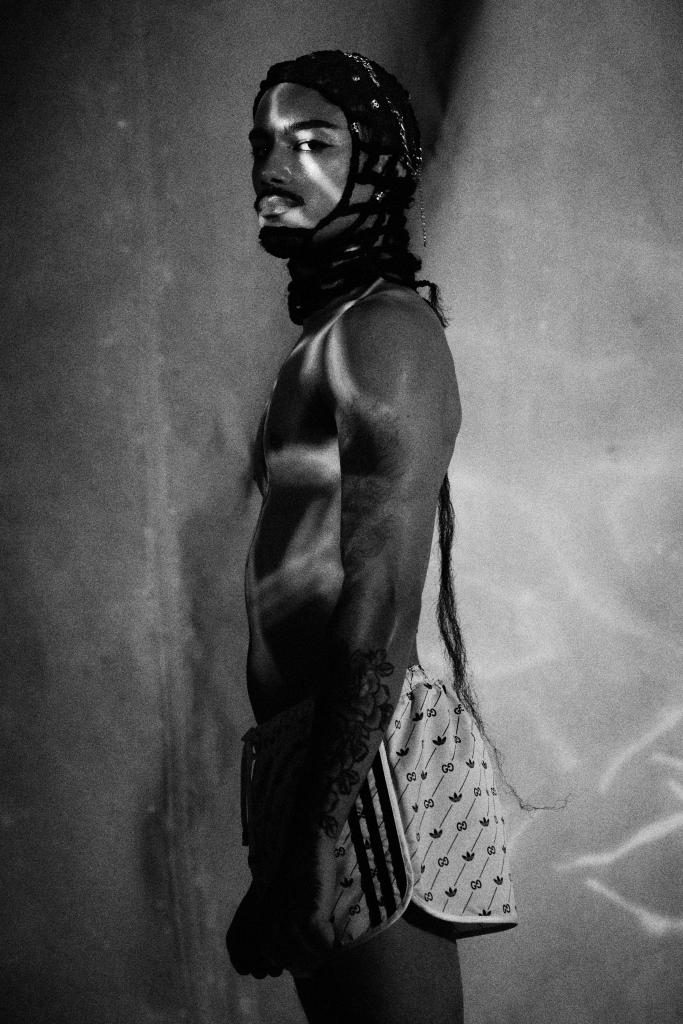
Shorts Pre-Loved Gucci X Adidas via Designer Exchange
Keiynan: Yeah, that’s the best. I think collaborative efforts are so special. When you rock up to a shoot that you didn’t plan yourself, you never really know what you’re walking into. You can get mood boards and references and all that stuff, but you still never know exactly how it’s going to come together. I love that feeling when you look around and realise everyone’s been preparing their own little bit of magic, and you’re like, ‘Okay, we’re just going to play.’
Reece: Yeah, they went IN.
Keiynan: Not everyone is a chameleon, you know? Not everyone has lived a life of that kind of fluidity, where they’ve had to move between different spaces and learn how to embody them. You’ve really been able to exist across a spectrum — from the masculine to the feminine — and move between those worlds in a way that feels very natural.
I have so many questions. I want to come back to the chameleon aspect, but I also really want to know whether there was a specific point in your life when you felt comfortable stepping into that space of queer visibility and embodying it for other people. Was that a conscious decision, or did it just happen?
Reece: It was definitely a conscious decision, but I think it was also a bit of a rebellious one. The first time I did a shoot that felt really queer and creative — wearing womenswear and embracing that kind of expression — was for my first cover with Risk magazine. The shoot was actually supposed to be for a different publication, who I won’t name. But when they saw the images, they felt it was too gay. They felt it was too expressive in that realm. It wasn’t what they wanted, and we ended up getting dropped. That’s how Risk magazine ended up picking it up and publishing it. That experience was the first moment where I realised, ‘Oh, there are going to be consequences if I do this.’ But at the same time, it felt like the most authentic thing I’d done so far.
I remember thinking, ‘Why wouldn’t they like it?’ It felt so natural to me. Then, with age and maturity, I started to understand how people view sexuality and expression, especially within fashion. On one hand it’s celebrated, and on the other it’s completely shunned because people still want to put things into boxes, particularly around gender. I was sad when the original publication dropped it. But then when another magazine picked it up and celebrated it, that gave me fuel. It made me think, ‘No, there are people who are going to connect with this. There are people who will support it and see how great it is.’ So if I had to pinpoint a moment, it was definitely that first Risk magazine cover.
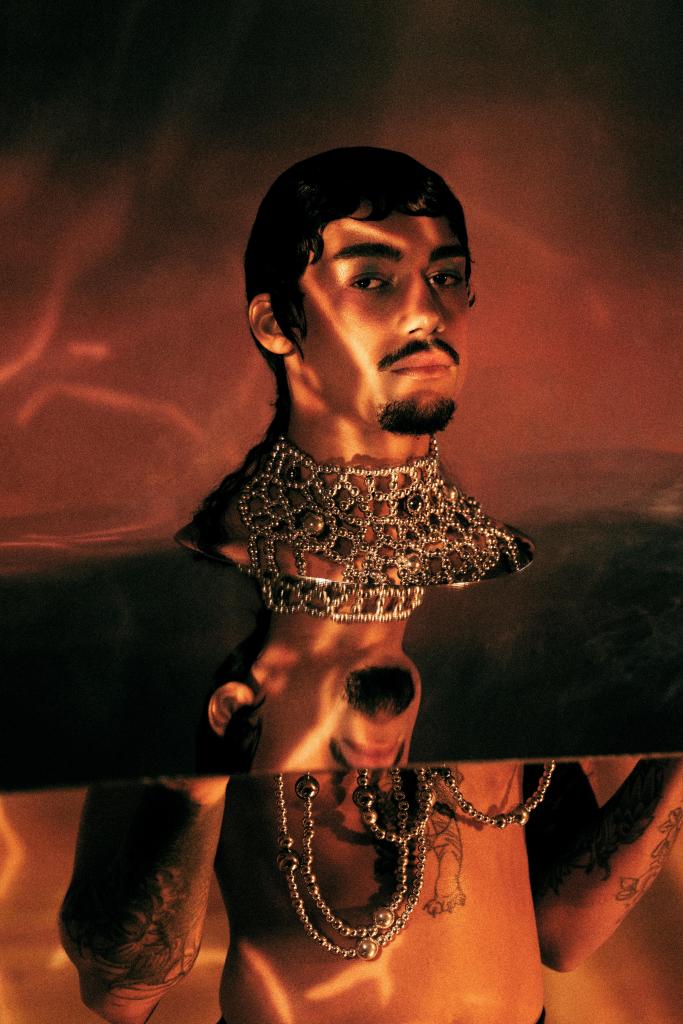

Necklace T Label
Keiynan: Yeah. Well named. And it’s true — everything has its audience. It’s crazy what someone taking a risk can do for other people. We’ve talked about this before, and maybe you never fully realised the extent of it, but I was following you on Instagram for a long time, and you were one of the first people I saw who was really embracing their sexuality and fluidity and challenging those ideas in such a visible way.
I saw myself in you, and that was one of the things that empowered me to own my own situation and my own expression. The risks you’ve taken and the creative instincts you’ve trusted have been really powerful. They impact people. They create a ripple effect. So thank you for that.
And speaking of embodying different energies and being a chameleon, a little birdie told me you might be getting into acting. I want to know about this.
Reece: I kind of felt like I was already acting when I was modelling. I never really thought about actually acting. But then I auditioned for something, it went well, and it gave me my first real experience of being on that side of things. What I realised was that I actually really enjoyed it. Playing a character felt quite natural to me because I’d spent so many years doing that through modelling. The only real difference was that I wasn’t delivering lines. So yeah, it felt like a very natural transition. I can’t talk too much about it because the project I worked on isn’t out yet, and they’re keeping me on a pretty tight leash to make sure I don’t spoil anything. But what I can say is that it was a really good experience, and it definitely made me want to do more. That’s something I’m hoping to make a reality going forward.
Keiynan: I do want to know what excites you about acting and that whole world. I think you’ve touched on it a little already with the character work. But is there anything that scares you about it as well?
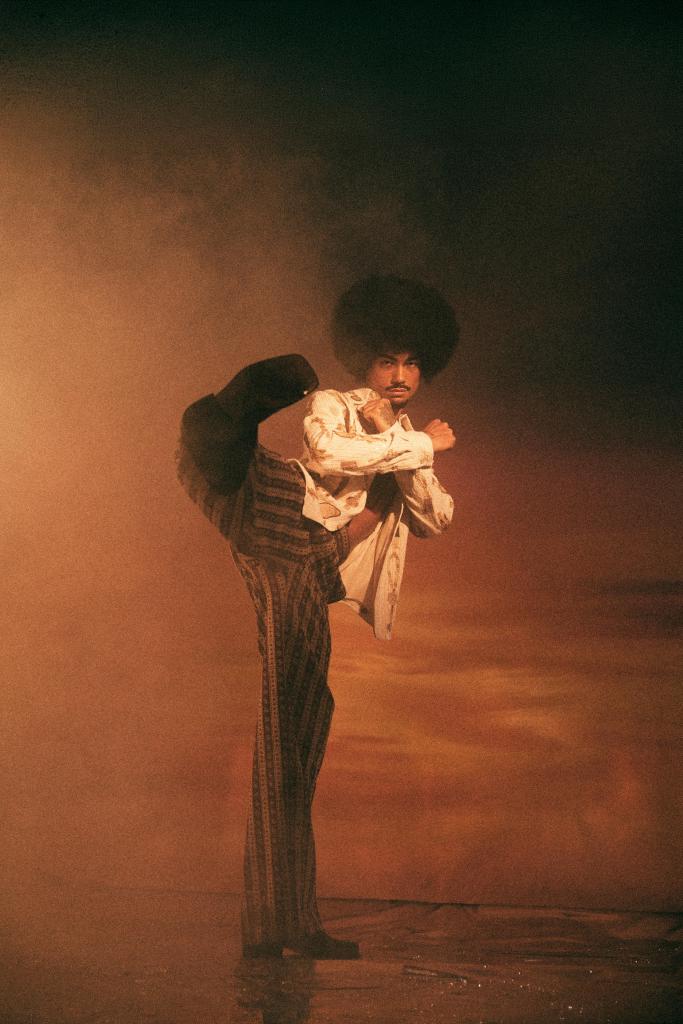

Shirt and trousers Amiri / Shoes Roker
Reece: In a way, the thing that excites me about acting is also the thing that scares me: the fact that I don’t have to be perfect. I had a conversation about this on set. Over time, modelling has kind of conditioned me to feel like I need to be perfect, or at least aim for perfection. But with acting, I quickly realised, ‘Oh, wait, I can be messy. I can be human.’
At first, I approached it the same way I unconsciously approach modelling. I was trying to get everything right. Then the director was like, ‘You know you can improvise, right? You can play around. You don’t have to do it exactly as written.’ Once I was given that freedom, something clicked. I realised I could just be more free. That’s honestly the best word for it. At the same time, that freedom scared me because I’m so used to slipping into a certain version of myself whenever I see a camera. I don’t even mean to do it. It’s just muscle memory at this point after ten years of modelling. But after that conversation, I could see from people’s reactions that they were more interested when I was being a person rather than just a body or a face.
That was exciting, but it was also scary because I had to consciously work against everything I’d trained myself to do in front of a camera. It felt like I was unlearning something while learning something new at the same time. But it also felt right. When I really thought about it, I realised I’d been playing characters my whole career anyway. Whether it’s through the clothes, the concept, the mood or the world you’re creating, you’re always stepping into a role. The only difference now is that I’m speaking. So I was like, ‘Okay, I can do that.’
Keiynan: I came from dancing before I went into acting, and a lot of dancers I speak to who’ve made that transition — myself included — say one of the biggest adjustments was learning to use our voice. As dancers, we’re used to being told, ‘Move here, do this, make it look like that.’ It’s actually quite similar to modelling in that way. I’ve always had a particular relationship with my voice. Obviously, I sing as well, so it’s something I’m very conscious of. What is it like for you to use your voice in that way? How does it feel? Because from what you’re saying, it sounds like it comes quite naturally to you and that you’re not overthinking it too much.
Reece: I think I overthought it at first. But once I got into the swing of it, I stopped overthinking and just started having fun with it. I think because it was my first real opportunity to speak on camera, it made me want to give it everything. I was like, ‘You know what? What’s the worst that can happen? I’ve already got the opportunity, so let me just do what I’m here to do.’
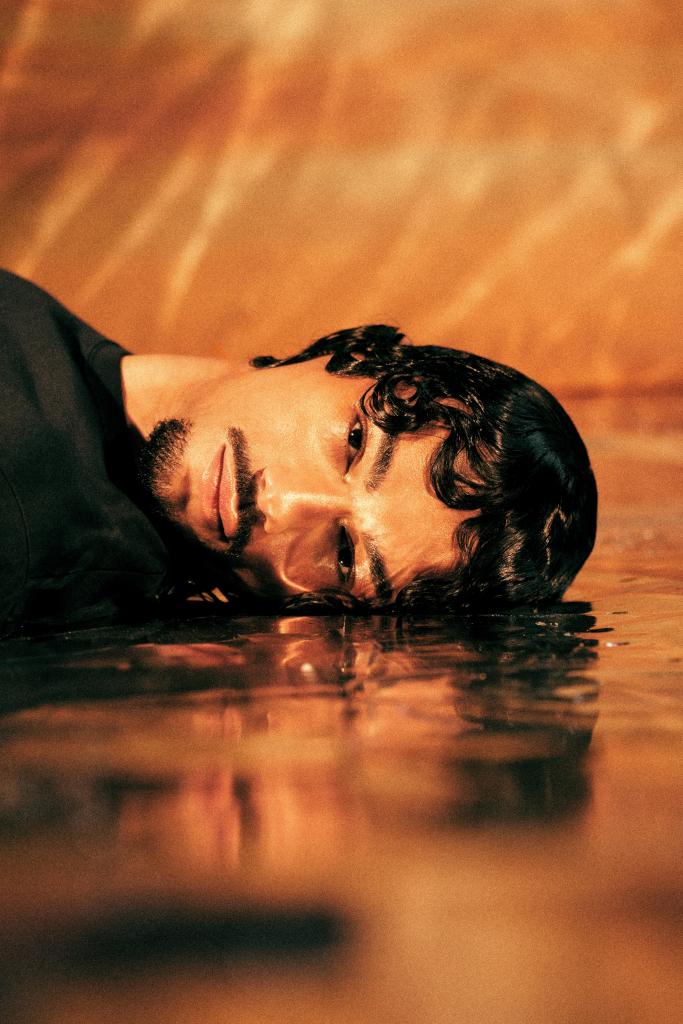
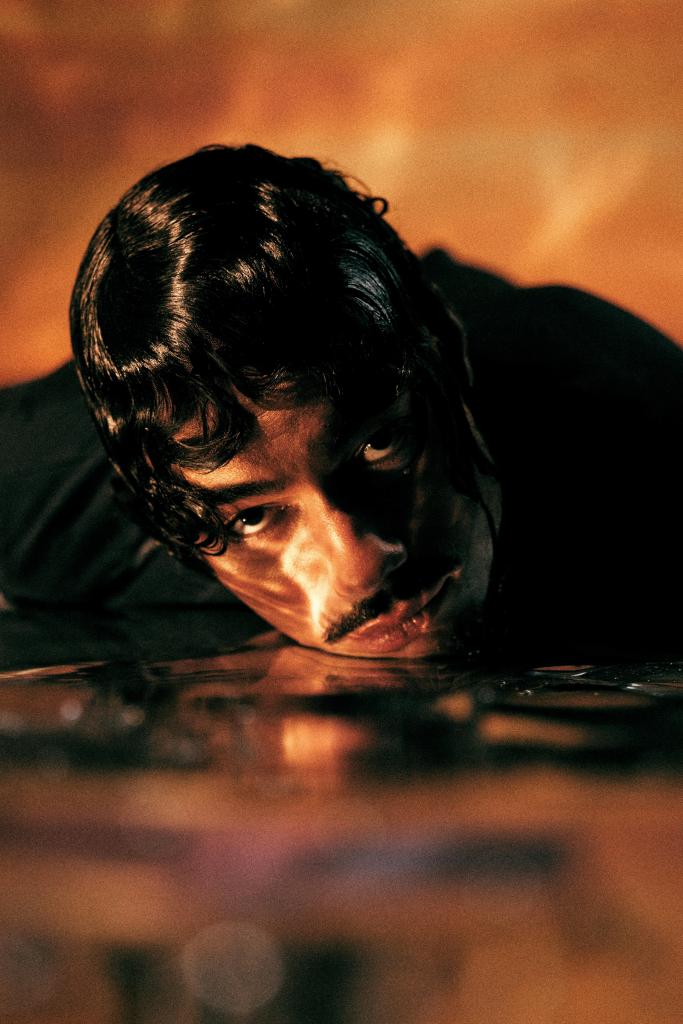
Top Geordie Campbell
It felt really fun because it was the first time I’d done it seriously, or for an actual project. More than anything, it gave me a sense of belief that I can do it. I think that’s the main thing I took away from it. It was almost a feeling of relief. The way I was navigating that space was something I haven’t really been able to do within modelling. It felt like I didn’t have to worry about finding the perfect angle or be hyper-conscious of how I was presenting myself.
Because I was playing someone else, but at the same time still bringing parts of myself to it, it gave me permission to stop overanalysing how I looked and how I was being perceived. It became less about my appearance and more about what I was bringing through my energy and my voice. That felt really refreshing. It felt new, and it was a lot of fun.
Keiynan: This is such a broad question, but it’s one I really want to ask. Who is Reece King today? Not the model, not the creative, not the public figure — who is Reece King the person right now?
Reece: That is one of the questions I hate. My whole life, whenever someone asked me, ‘What’s one thing you really hate being asked?’ I would always say, ‘Who are you?’ Or, ‘Describe yourself in three words.’
Any variation of that question used to give me immense anxiety. I’d immediately be like, ‘Oh my God, don’t do this.’ But I think I’ve reached a place now, at 31 years old, where if someone asks me who I am, I don’t even talk about my job anymore because that’s what I do, not who I am. Who I am is a son, a grandson, an uncle, a best friend. I try to be a role model, although I don’t think about that too much.
The truth is, who I am exists in my real personal life. It’s all the things that nobody online sees and that people who don’t know me personally will never really know about. I can’t really put specific words on it. I just know that’s where the real version of me lives — when I’m not being seen or perceived by people who only know me from the internet or from work. Very vague. Very Scorpio. But honestly, that’s the truth.

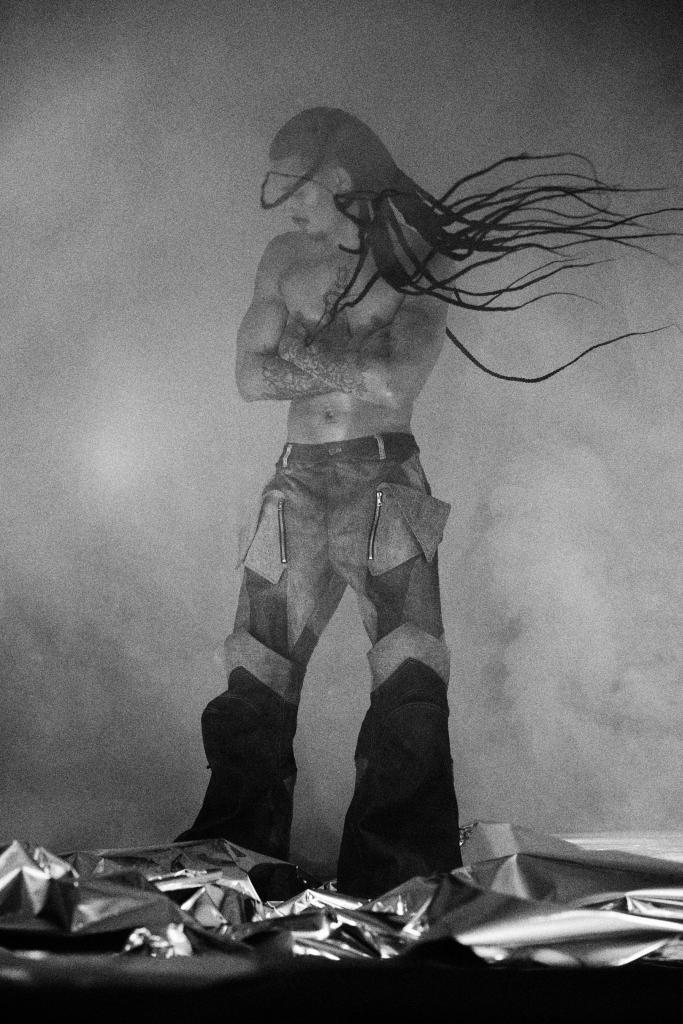
Trousers Yunli
Keiynan: No, it’s good though. And I think there’s something really beautiful about that. At the end of the day, people can ask you anything, but it’s your response that matters. So it’s lovely that the question doesn’t bring up the same level of anxiety anymore because you’ve figured out which parts of yourself you’re willing to share and talk about. I actually think that’s one of the healthiest things you can do if you’re building a sustainable career in the public eye.
How do you think about success these days? What does success mean to you now?
Reece: It’s definitely changed over the last ten years. If you’d asked me that years ago, my answer would’ve been completely different. Back then, I probably would’ve said success was working with a certain person, being seen in a certain room, having a certain amount of money, or reaching a level that other people see as something worth achieving.
But now, success is much simpler. For me, success is having some level of comfortability in life. Just being able to exist, survive and find a bit of peace in all the craziness that we’re all dealing with. And it’s not even just financial comfortability. It’s comfortability within myself. It’s having a sense of self and feeling grounded in who I am. Of course, money matters. It makes the world go round, and this is still a job at the end of the day. But honestly, success for me now is having some sense of comfort and peace through the work that I’m lucky enough to do.
Keiynan: Feels like marrying peace with career is a huge one. I’m not sure how much time we have, but I do have another question — which is hilariously escaping my mind as I’m about to say it. Because of this crazy world, and because you’re an artist and what we do becomes so wrapped up in so many things beyond just the personal experience, is art still a place of retreat for you? In your personal time, is that one of the ways you’re able to soothe things and find some grounding in the world we’re navigating?
Reece: Always. I feel like even if it’s art I’m doing just for myself, or something that’s being shared, that’s the one thing that actually keeps me going — being able to put myself into something creative or artistic in some way. I think I’m a very creative person, and whether it’s things I’m doing alone or for others, I feel like I naturally need that as an outlet in order to keep feeling alive. Not in the sense of being alive, because I would be anyway, but in the sense of actually feeling alive.
I think I’m always going to make room for art, because it feeds me the most. Even in modelling, which has been my main job for so long, it’s those moments — like Principle — where it feels like art, where it feels like creating something, that give me the most joy. Those are the moments I get most excited about. So I feel like no matter what I do professionally, I’ll always try to navigate towards something that leans into that, rather than away from it. And if other people get to see it, that’s even better. But there are also a lot of things I do just for myself that people will never see, and I still feel just as fulfilled by them.

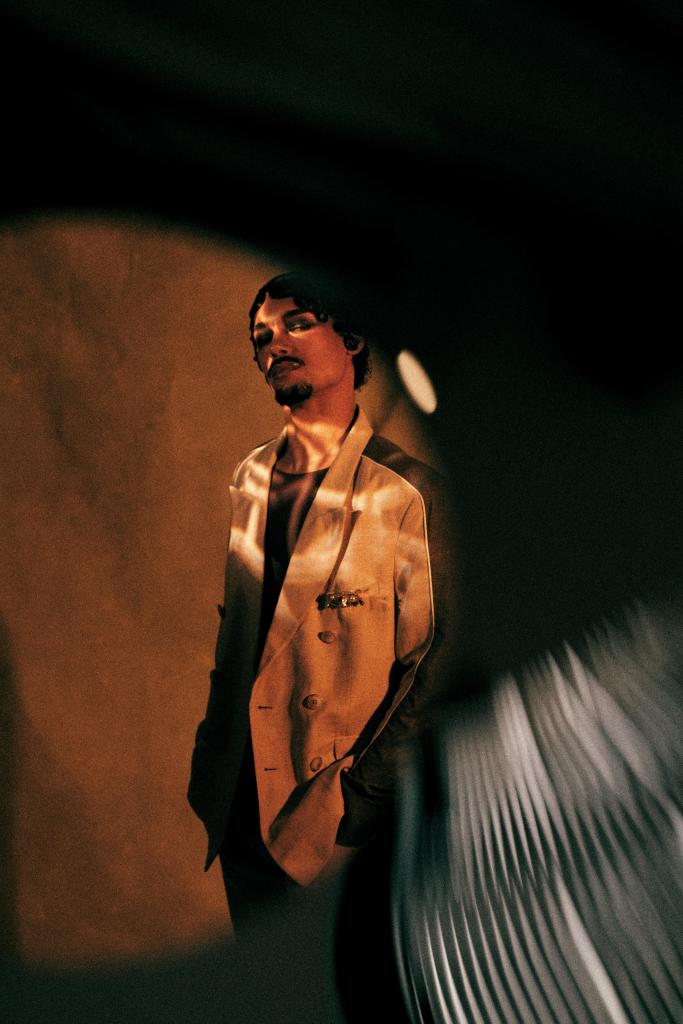
Suit Ahluwalia / Holding jacket David Koma
Keiynan: What’s some of the stuff people don’t see?
Reece: That’s a secret. No, joking.
It’s more so stuff like sculpting. I like to sculpt. I’ve shared some before, but I don’t really share them anymore. I did sell a couple, which was fun, but I mostly just like doing it for myself. Or I’ll give things to my cousins or my friends, like, ‘Oh, I sculpted this — I made this for you.’ I feel like it’s mainly sculpting. I do nails as well, which feels like sculpting, just on fingers. I’ll do nails for a couple of the girls in ballroom or in modelling, but I never really showcase that either. I might post a few things on my story here and there, but I don’t really attach it to myself fully or put it out there in a big way. There are a few things I do that I don’t share to the same extent as modelling. It just feels more personal. It doesn’t feel natural for me to share everything on social media.
Keiynan: Yeah. You’re not trying to market it. You’re not trying to promote it. That’s very sacred, I think.
It’s so cool to catch up with you. You’re going to need to do my nails when I’m in London. We’ve been trying to catch up for ages.
Reece: Oh my god, I will.