While most of us know the rather swoonsome Callum Scott Howells from his tragic role in It’s a Sin and his acclaimed work on the West End stage, it comes as something of a surprise to discover that one of his more niche obsessions is the notorious story of Carrie: The Musical — the infamous 1988 Broadway train wreck that attempted to transform Stephen King’s horror novel into a blockbuster musical destined to rival the success of Les Misérables. So fascinated has he become by the show’s spectacular collapse — and the mad creative shenanigans that went on behind the scenes — that he has immersed himself in Out for Blood, a podcast dedicated to unpicking exactly how it all went so spectacularly wrong.
PHOTOGRAPHY
Guy Lowndes
FASHION
Gary Salter
GROOMING
Lauraine Bailey using
Dyson Hair Pro and Dior Beauty
FASHION ASSISTANT
Marcie Lewis
“It is the single best podcast I’ve ever listened to,” he tells Principle enthusiastically over Zoom, just days after our lavish fashion shoot. “I’d never heard of the people behind it, but they do a deep dive into the failure of Carrie: The Musical. Basically, Terry Hands, who was artistic director of the RSC, wanted to create his own version of Les Misérables. He persuaded Stephen King to let him do it and got Debbie Allen from Fame to choreograph it. However, along the way there was a creative misunderstanding about Grease and Greece, which saw tensions run high. The podcast goes into it in so much detail. It is fucking epic.”
But today we’re not here to talk about the failures of shows gone by. Instead, we’re here to celebrate the marvellous Callum Howells.


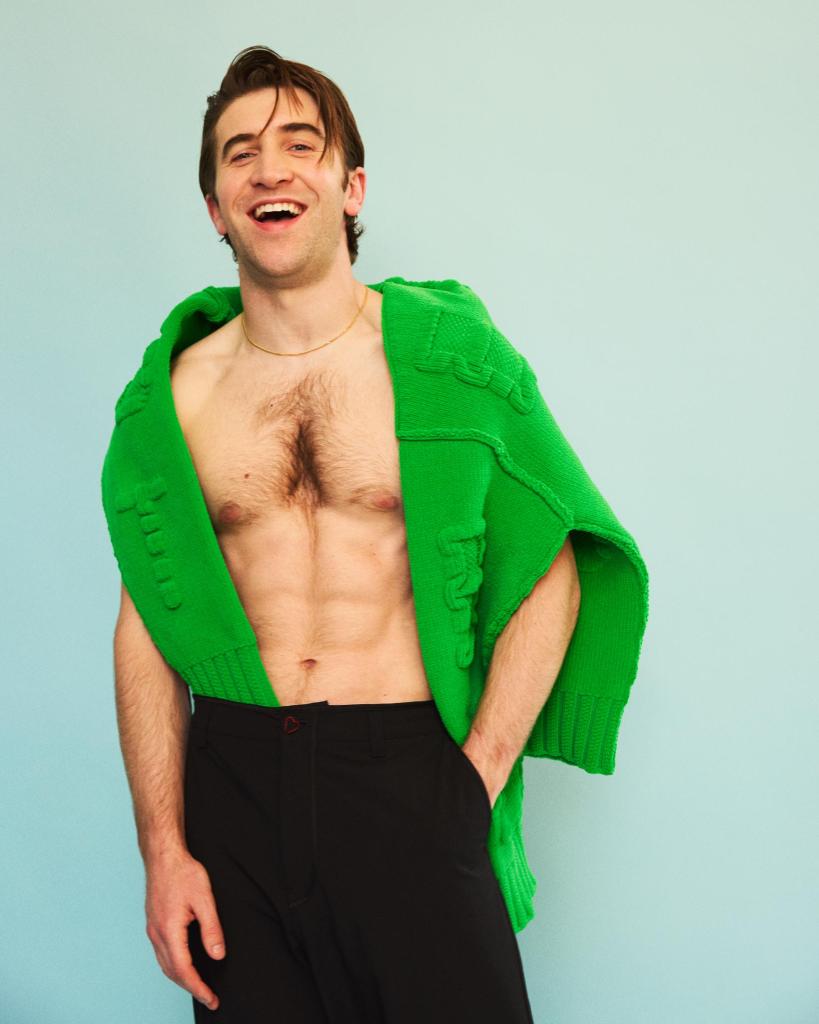
Jacket Mithridate / Socks Falke / Shoes Grenson / Necklace Callum’s own
Back in 2021, the young Welsh actor took our breath away in his heartbreaking role as doomed Colin in Russell T. Davies’s It’s a Sin. Critics and audiences alike were moved by his incredible performance and left stunned by what seemed to be a brand-new talent.
However, while many people saw Callum’s success as an overnight phenomenon, they might have been surprised to discover that they had probably seen him on their television screens for a decade or so before without even realising it, as he had been quietly slogging away in a variety of roles.
Back in 2012, Callum was one of 150 eager choirboys singing their hearts out with Only Boys Aloud, the Welsh choir that made it all the way to the final of Britain’s Got Talent. He also took part in Gary Barlow’s short-lived talent show Let It Shine, where he came close to reaching the final before pulling out after landing a professional acting job elsewhere.
But it was It’s a Sin that changed everything. As Colin, the sweet, shy young man who moved to London and found himself thrown into a whole new world, Callum delivered a performance that broke hearts and established him as one of the most exciting young actors around.
Since then, Callum’s career has gone from strength to strength, landing some of the most sought-after roles in London’s West End, most notably playing the Emcee in Cabaret, a role he tells us helped establish him as an actor capable of taking on a wide variety of characters.
Now he is about to serve up another character for us to savour: the real-life fifth Marquess of Anglesey, Henry Paget, a little-known member of the aristocracy who caused something of a scandal when he blew his family’s colossal fortune on staging lavish plays that no one saw, shamelessly wore flamboyant outfits, doted on his pastel-pink dyed poodles and whipped up so much controversy that, after he died at the age of just 29, his horrified family attempted to erase him from history.
But that is no longer the case. Henry’s dazzling and slightly sad story is now the subject of the madcap, colourful comedy Madfabulous, which sees Callum taking on the lead role of the eccentric aristocrat, a man with whom he has become absolutely fascinated — and perhaps even a little obsessed.


Jacket Feng Chen Wang / Vest 2.0 Lanes Studio / Shorts Feng Chen Wang / Socks Falke / Shoes Grenson
In this interview with Principle, just a few days after we photographed him for his stunning fashion shoot, Callum explains why he is so pleased that the fifth Marquess is finally getting his dues.
He also confides that, much like his character Colin in It’s a Sin, moving to London was an experience he sometimes found difficult to navigate — especially when it came to working out where he fitted in, who he could trust and how he could establish himself as the actor he truly wanted to be.
So Callum, this movie is a hoot. And yet tragic. What was it about Paget’s life that made you feel excited about him? He’s rather phenomenal.
I genuinely didn’t know anything about him, and a lot of people I spoke to hadn’t known him either. So it really took a lot of digging because — and this is the really sad thing about him — the family destroyed so much of the evidence: files, personal things, diaries and stuff. And that made this story all the more engaging for me. It became a really big hook because it was like, ‘Well, this is really interesting and kind of scandalous.’ And that’s always very intriguing for an actor.
It must have been fun to really dig into his life. Was it hard to find out a lot?
Well, there was the script to start with, but then I also did my own research, digging around online and reading source material. I also have a really good friend called Seiriol Davies, who wrote a musical about him called How to Win Against History, which had a run at the Bristol Old Vic last year. So I went for lunch with Seiriol, and he told me that when he visited the house many years ago there was nothing there to mark his time there apart from a tiny little plaque that said ‘The Fifth Marquess’, while all the other marquesses have these amazing shrines because they served in the army or did amazing things for the country. Obviously they should be remembered, but it’s so sad that the man who did the butterfly dances, put on shows and wore extravagant clothes had nothing there to show for it for years.
What’s kind of crazy now is that, because of the film, they’ve got a whole room dedicated to him, with costumes from the film — costumes I wore in the film. I am so pleased because I think he’s extraordinary, and I’m so fascinated by him and always will be now.

Jumper Bottega Veneta via Designer Exchange / Trousers Fiorucci / Shoes Grenson
It’s wonderful that people who were erased from history finally get their moment to shine, like they do in your film.
As I was doing my research, I found out that so many people from all walks of life had been inspired by him. Not just in fashion, like Harris Reed, but also in music. What I find sad is that there was this man, this marquess, who wore these clothes, put on these plays and caused something of a scandal, and all he wanted was to be remembered. I think he wanted to have a legacy. Obviously, his family didn’t approve, so there was conflict there.
Yes, there’s a scene in the film in which Henry says to someone painting his portrait, ‘Will this be seen outside of where we are?’ So he obviously wanted to be remembered in some way.
I really believe that, in his own way, he was trying to do his family proud. I think because his peers at the time were people like Arthur Conan Doyle, who were storytellers, I reckon he wanted to tell a story of some kind. I think he was trying to do something positive. I don’t think he was just trying to be selfish or ruin the family name. I think he was misunderstood to a massive degree. But I think he had trouble getting to grips with his role.
He grew up in France and came to Wales really by accident, as he had inherited the title. I suppose, telling the story now, we can empathise a bit more, I hope, with how much progress has been made through the years.
The tragic part is he only lived until he was 29.
Yes, he died of consumption. He was a very, very unwell person. The poor man was constantly fighting against something, whether it was society’s expectations of him or his physical health. He was always up against it. He was a fighter, someone who came out all guns blazing. He had to. It’s a fascinating life and very tragic.
Did you ever experience anything like that yourself?
When I was young, I fell into acting and performing in the Valleys, and that came with its own presumptions and stuff. But I kind of embraced it, in a way. I never really let the name-calling affect me. I had a very thick skin. I think it comes from the fact that I had very supportive parents and family, which I feel very lucky for. They always lifted me up and were never like, ‘Oh, don’t do that. You need to do something proper,’ like, ‘Go down the site,’ or, ‘Go and follow your uncle,’ or whatever. It was always a very positive household. And I think that’s where it came from.
Was acting always a passion?
Yes! Acting and performing was never a way for me to brag. It was just something that I really loved. I grew up loving TV. I loved going to the theatre. I loved storytelling. And it was never a way to be like, ‘Oh, here I am.’ I really cared about it very deeply, and I wanted to be part of it.


Printed blazer, shirt, and printed trousers Denzil Patrick / Shoes Grenson
That’s great. A lot of people doubt themselves and miss out on doing the things they should be doing.
Well, you see, I was never one of those people who thought that living in the Valleys would stop me from doing stuff. I came from a community that was always very supportive and uplifting. I was always told you can do whatever you want to do. It wasn’t like a Billy Elliot story where I was told, ‘You’ll have to be here forever going down the mines.’ That was never my experience. It was always, ‘You are allowed to dream. You are allowed to have ambition.’ And I suppose it was that that carried me through.
Yes, you joined the choir Only Boys Aloud, which made it on to Britain’s Got Talent.
We got to the final and you can see me in the front row in one of the shots, which is hilarious.
What did you take away from that experience? Because that must have been one of your own mad, fabulous moments — a boy from the Valleys on national television, in the final.
Oh, totally. I remember we were queuing in the Britain’s Got Talent studio and we entered from both sides of the studio onto the stage. We were waiting by the bleachers where all the audience sit, and Ant and Dec walked past us. I was like, ‘Oh my God, it’s Ant and Dec.’ I couldn’t believe my eyes. We’d seen them in the previous rounds, but them walking past us was kind of different. It was like, ‘Oh my God, it’s those guys I watched on SMTV Live growing up.’ So it was a really, really big deal. But it was terrifying. So scary.
So you enjoyed it then?
I did, because I was part of a big group. I couldn’t have gone on Britain’s Got Talent on my own. That would’ve been too scary. I would’ve drowned. I think being with that group of boys, all coming from Wales and being part of the same choir, there was a big camaraderie there.
And that goes for all the choir because Tim Rhys-Evans, who was our choirmaster — and is now a very, very dear friend of mine — was such an amazing role model to us all. That choir was all about teamwork. It was all about being as one. It was never about competition. It was never about being better than anyone. It’s such a beautiful organisation. Only Boys Aloud represented something so precious and brilliant. So I loved being part of it.


Shirt, leather trousers, and tie BOSS
Obviously, you eventually did go it alone and appeared in the highly praised It’s a Sin. The show was so huge it must have transformed your life.
It was the biggest shift in my life, 100 per cent. It was when I had to really get to grips with myself, and it took a while. It took a long time. To say it happened overnight is not how it was at all.
Of course, my visibility shifted pretty much overnight. The day after the show aired, I was out walking my dog and people were coming up to me crying in Bute Park in Cardiff. It was kind of crazy overnight. However, my journey from then until now has had ups and downs — a very, very extreme version of both. It’s not been easy.
Do you mind if we ask what you mean by ups and downs?
The ups are there to see, but the downs are things like going nine months without working and not knowing what I’m going to do next. And then moving to London was tough, because after It’s a Sin it was very easy to think, ‘Oh, you’d have so many options.’ And to a degree, that’s true.
But I really wanted to prove my stripes as an actor. It was about leaving Colin behind and showing that I’m actually capable of so much more. I’d shot a movie called The Beautiful Game, which was great and I had a lot of fun doing. But I wanted to show that I could do something else, and that came with going a long time without working because a lot of the things that came through were very similar to Colin.
That’s brave.
So then it wasn’t until Cabaret came to the West End, and I’d said to my agent, ‘If Eddie is going to leave the show and it’s going to continue, I’d love to do it.’ I wanted to go back to my musical theatre roots and get into a role where I’d be able to really show what I’m capable of.
“When I auditioned for Cabaret, it was a tough audition. I was in the room for about an hour and a half with the director, Rebecca Frecknall, and she really pushed me to show her that I could do what it requires to play the Emcee. I was twenty-three and probably one of the youngest Emcees to play the role in a big production.
And it was only after I did it that I was able to fully pursue different roles because I’d shown people that I could rise to a different challenge.


Jumper Bottega Veneta via Designer Exchange / Trousers Fiorucci / Shoes Grenson
Was moving to London an eye-opening experience?
When I first moved there, I didn’t like it at all. I felt lost, to be honest. I didn’t feel fully part of it. I felt like I was trying to fit in, and I’d have moments where I would, but I’d also have moments where I was like, ‘What am I doing here?’ And I don’t think that’s to do with where I came from. I think it’s just to do with where I was. You also can’t ignore the fact that we’d just come out of a global pandemic. We’d spent so much time in our gardens or in our houses. I also met so many people, some of whom were not great influences.
It wasn’t until about two years in that I began to think, ‘Oh, I’ve found a comfortable way of living.’ I know where my local park is. I know what I like to do in the morning for breakfast. It was finding those little moments throughout the day where you can think, ‘Oh, this is home now. This is my community, and these are the people I love spending time with.’ It took about two and a half years to really do that. And it also came through work. Theatre was a godsend for me.
Yes, work started to pile in.
After Cabaret, I did Romeo and Julie at the National Theatre, and they were my kind of plinths that allowed me to find my way. I suppose a lot of actors, particularly old-school actors who only did theatre growing up, can probably relate to that. I found community very easily through doing theatre. And obviously I’m super grateful for it because I was then able to find my feet. Now I love London. I couldn’t imagine living anywhere else — for now, at least. I adore it.
You were in New York recently — could you imagine living there?
It’s like London on crack, right? It just goes on and on and on every day. The days never end. But I saw some amazing stuff. I went to see Ragtime at Lincoln Center, which was beyond awe-inspiring. It was just unbelievable. There was a thirty-two-piece orchestra, with Caissie Levy, who’s an icon to me, and Joshua Henry, who has a voice unlike anything I’ve ever heard in my life. So I loved that.I also saw Luke Evans in The Rocky Horror Show, which was brilliant. It’s such a great show. It’s so much fun, and Luke is just so captivating as Frank. His entrance — I’ll never forget it. It’s up there with one of the greats. He’s fantastic in it. And it’s at Studio 54 as well, which was a lovely surprise.
‘Madfabulous’ is in cinemas June 5th, 2026